
The global aerospace manufacturing ecosystem demands unparalleled strictness in structural integrity, weight optimization, and component traceability. For production engineers and procurement heads responsible for fabricating complex fluid lines, engine manifolds, structural airframes, and fuselage trusses, traditional cutting technologies no longer suffice. Integrating an advanced tube laser cutting machine aerospace system into your production floor is the definitive mechanism to achieve the microscopic tolerances, geometric versatility, and absolute repeatability mandated by international aerospace standards. As regulatory pressures intensify and lightweight structural engineering evolves, high-performance laser processing stands as the line between baseline compliance and true market leadership.
For the full context on precision requirements across aerospace laser processing,: Why Aerospace Manufacturers Need High-Accuracy Laser Processing covering tolerancing, compliance, and the production case for laser-based aerospace fabrication.
Why Aerospace Tube Components Need Precision Laser Cutting
Aerospace tube engineering operates on the cutting edge of physical possibilities. Components such as hydraulic lines, high-pressure fuel conduits, environmental control system (ECS) ducting, and engine mounts are subjected to extreme thermal cycles and high vibration environments. Consequently, structural micro-cracks or heat-affected zones induced during fabrication can lead to catastrophic component failure.
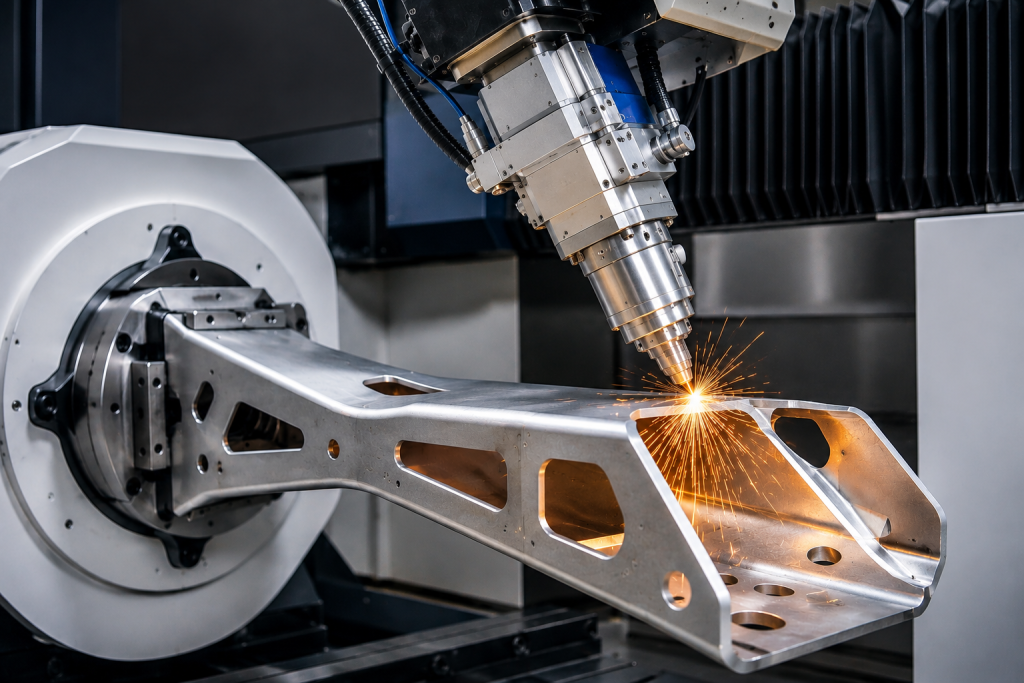
Deploying a dedicated tube laser cutting machine aerospace production configuration provides non-contact material processing, which completely eliminates mechanical stress on delicate, thin-walled tubing. Modern laser cutting mechanisms focus multi-kilowatt energy onto a highly concentrated spot size, minimizing the Heat-Affected Zone (HAZ) and preserving the metallurgical properties of critical alloys. This micro-precision ensures every scalloped edge, fish-mouth joint, and complex profile meets tight tolerance thresholds without degrading the baseline material structure.
Challenges in Aerospace Tube and Profile Fabrication
Aerospace component manufacturers regularly encounter manufacturing hurdles that stall throughput and inflate scrap rates when utilizing legacy processes:
- Tight Tolerance Tube Processing: Maintaining dimensional variations below $\pm0.05\text{ mm}$ across intricate, curved geometries and thin walls.
- Profile Cutting Accuracy: Standard mechanical saws, milling equipment, and manual plasma cutters induce micro-shearing, deformation, and imprecise edge profiles on non-cylindrical shapes.
- Complex Tube Geometry Cutting: Complex interlocking profiles, counter-sunk holes, and specialized slots required for weight-reduction patterns are incredibly difficult and costly to machine traditionally.
- Material Deflection: Thin-walled aerospace tubing easily warps under the mechanical clamping forces required by traditional CNC milling and sawing equipment.
How Tube Laser Cutting Improves Aerospace Manufacturing Accuracy
Transitioning from mechanical machining centers to an industrial tube cutting machine engineered for aerospace standards transforms production metrics by addressing core performance drivers:
Profile Cutting Accuracy and Repeatability
By executing multi-axis CNC movements backed by real-time optical tracking, modern laser systems deliver exceptional profile cutting accuracy across complex contours.
Manufacturing Process Comparison Matrix
| Manufacturing Parameter | Traditional Mechanical Cutting (Sawing/Milling) | Advanced Tube Laser Cutting (SLTL Systems) |
| Dimensional Tolerance | $\pm0.25\text{ mm}$ to $\pm0.50\text{ mm}$ | Up to $\pm0.03\text{ mm}$ to $\pm0.05\text{ mm}$ |
| Heat-Affected Zone (HAZ) | None (but causes severe mechanical strain) | Ultra-minimal, localized thermal control |
| Secondary Operations | Extensive deburring, cleaning, and edge-dressing required | Ready for immediate assembly or welding |
| Complex Geometries | Highly restricted; requires multiple setups and custom jigs | Unlimited 3D profiles cut in a single, automated pass |
| Material Yield / Scrap | High wastage due to wide blade kerfs and clamping margins | Maximum nesting efficiency with sub-millimeter kerf width |
Materials Used in Aerospace Tube Laser Cutting
Aerospace engineering relies on advanced metallurgy to construct lightweight structure fabrication systems capable of resisting aggressive forces. High-end tube laser systems handle these sophisticated materials effortlessly:
- Titanium Alloys (Grade 5, Ti-6Al-4V): Widely deployed for structural framing, engine components, and hydraulic ducts due to its high strength-to-weight ratio. Advanced fiber lasers cut titanium cleanly using inert assist gases to prevent oxidation.
- Inconel & Hastelloy (Nickel Superalloys): Essential for hot-section engine parts and exhaust systems.
- Aircraft-Grade Aluminum (6061-T6, 7075): Preferred for structural fuselage tubing and internal framework. Fiber lasers overcome aluminum’s natural reflectivity with tailored laser frequencies to prevent back-reflection.
- Stainless Steel (304, 321, 21-6-9): Applied frequently across high-pressure lines and hydraulic tubing, demanding pristine edge finishes free of micro-burrs.
Beyond standard tube configurations, advanced laser architectures support specialized material processes including sandwiched aluminium sheet cutting and high-performance composite cutting, giving defense and aerospace manufacturers complete fabrication capability across standard structural plates and custom extruded profiles.
SLTL Laser Solutions for Aerospace Tube Processing
Sahajanand Laser Technology Limited (SLTL Group) designs, builds, and deploys high-accuracy laser systems customized to meet the strict demands of the aerospace supply chain.
Industrial Laser Cutting Systems
- Future X: The pinnacle of advanced laser cutting machine engineering. Outfitted with intelligent CNC controllers and adaptive optics, it provides the supreme accuracy required for micro-tolerances in thin-walled aerospace tube cutting assemblies.
- Infinity F1: A high-power, heavy-duty cutting machine designed to cut through thick-walled structural tubes and large extruded profile geometries without losing geometric accuracy over long production runs.
- IntegreX: An affordable productivity laser cutting machine designed for fast setups and versatile part changes, making it ideal for tier-1 suppliers juggling low-volume, high-mix component batches.
- X5 (3D Laser Cutting Machine): Equipped with a dynamic 5-axis articulated cutting head, the X5 handles multi-dimensional profile cutting, allowing for compound bevel cuts, countersinks, and complex intersections on curved aerospace tubes.
Quality Control, Traceability, and Workflow Integration
Aerospace manufacturing dictates absolute component traceability from raw mill stock to active service lifecycle. The component processing workflow must ensure that after parts are cut, they are instantly identifiable
For high-integrity tracking, SLTL offers specialized Laser Marking Machines configured for 2D/3D marking, permanent alphanumeric serialization, and precise aerospace name plate marking directly onto raw metals or treated surfaces:
- Nova & REX: High-reliability diode marking systems configured for permanent, stress-free component traceability.
- ELITE: Fiber laser systems capable of ultra-fine, contrast-rich hallmarking without altering structural integrity.
- Flexy: A portable diode marker ideal for tracking oversized structural profiles or assembled airframe tubes on-site.
- NEO & Ultra: Multipurpose and low-power fiber laser systems providing rapid, burr-free marking on sensitive electronic and hydraulic enclosures..
Choosing the Right Tube Laser Cutting Machine for Aerospace Production
Selecting the optimal machinery requires manufacturing heads and procurement teams to evaluate specific operational parameters:
- Dimensional envelope and wall thickness: Ensure the chuck capacity matches your longest structural profile and the laser power matches your thickest nickel superalloys.
- Axis configuration requirements: Opt for multi-axis 3D cutting heads (like the SLTL X5) if your designs rely heavily on complex saddle joints, complex beveling, or non-perpendicular cross-penetrations.
- Software integration: Look for seamless CAD/CAM interfaces that easily translate native aerospace design files into precise nesting patterns, optimizing material usage and lowering scrap rates.
- Comprehensive workflow expansion: Ensure your tube processing center naturally complements down-stream assembly steps. To maximize floor efficiency, explore how high-accuracy cutting layouts integrate with automated welding systems and specialized traceability lasers. For a deeper breakdown of how high-accuracy laser systems improve overarching factory throughput.
Bottom-of-Funnel FAQs
Q1: How does a tube laser cutting machine handle reflective aerospace materials like aluminum and copper? A: Modern SLTL fiber laser systems are equipped with integrated back-reflection isolation technology. This prevents returned optical energy from damaging the laser resonator, allowing continuous, high-speed cutting of highly reflective aircraft-grade aluminum alloys (such as 6061-T6 and 7075) and copper-based electrical components without process instability.
Q2: Can SLTL systems cut complex non-cylindrical shapes, such as teardrop profiles or asymmetrical structural channels? A: Yes. Our systems feature intelligent rotary chucks and multi-axis 3D laser heads driven by smart CAD/CAM nesting software. This allows the machine to adjust its focus height and cutting angle dynamically, ensuring precise execution of profiles across square, rectangular, oval, teardrop, and custom-extruded structural sections.
Q3: What are the primary maintenance requirements for keeping these laser systems at aerospace-grade calibration? A: Solid-state fiber laser sources require virtually zero maintenance compared to legacy resonators. Daily operations are restricted to cleaning the external protective optics, checking nozzle condition, and maintaining clean guide rails. SLTL also provides scheduled calibration services to guarantee the machine continues to operate within certified aerospace limits.
Q4: How does implementing an automated tube laser system reduce material waste on expensive alloys like Inconel? A: Traditional cutting methods require substantial physical gripping areas, leading to extensive remnant scrap. SLTL’s advanced nesting algorithms and compact chuck designs allow parts to be nested tightly together.