
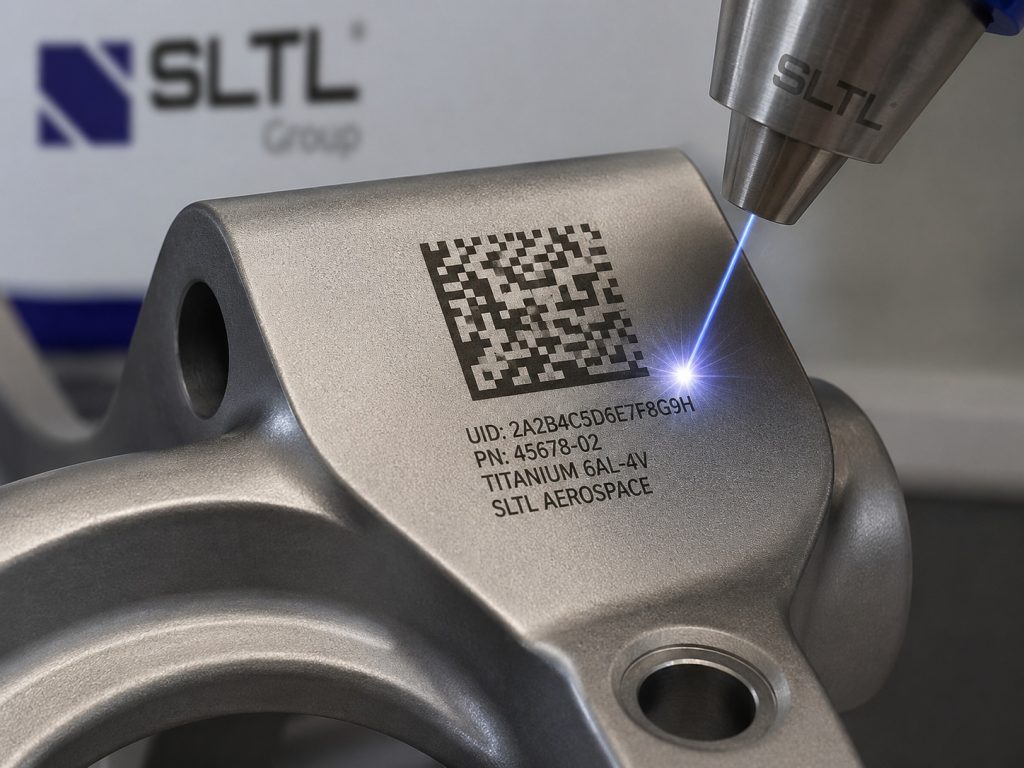
Every aircraft component must tell its story where it was made, by whom, from what material, and when. That story is permanently encoded in a mark: a QR code on a titanium bracket, a serial number on an aluminium panel, or a datamatrix on a composite fastener plate. Ultimately, choosing the right laser marking machine for aerospace traceability determines whether that story remains readable 30 years later, or becomes lost after the first maintenance cycle.
This guide is written specifically for aerospace OEMs, Tier-1 and Tier-2 suppliers, and precision engineering companies that need permanent, compliant, and production-ready laser marking solutions. Throughout this guide, we cover what the standards require, what the machines must deliver, and exactly which SLTL systems match each aerospace marking application.
For the full context on precision requirements across aerospace laser processing, Why Aerospace Manufacturers Need High-Accuracy Laser Processing — covering tolerancing, compliance, and the production case for laser-based aerospace fabrication.
Why Aerospace Traceability Requires Precision Laser Marking
The Compliance Standards That Govern Aerospace Marking
Several international standards define what aerospace marks must achieve:
- MIL-STD-130N Department of Defense UID marking for all items valued above a threshold
- ATA 2000 / iSpec 2200 Identification and traceability for commercial aerospace components
- AS9100D Quality management system requiring documented part identification throughout production
- EASA / FAA Part 21 Design and production organisation approval with mandatory part marking requirements
Together, these standards require marks that are:
- Permanent surviving the full operational life of the aircraft (20–40+ years)
- Heat and corrosion resistant maintaining readability after thermal cycling, chemical exposure, and UV degradation
- Machine-readable datamatrix codes must achieve a minimum print quality grade under ISO/IEC 15415
- Non-damaging the marking process must not introduce stress risers, micro-cracks, or surface contamination
Why Laser Marking Outperforms Every Alternative
Conventional marking methods inkjet, stamping, and electrochemical etching — fail one or more of these requirements. Ink fades over time. Mechanical stamping creates stress concentrations in fatigue-sensitive parts.
By contrast, laser marking delivers a unique combination of advantages:
- Zero-contact processing no mechanical force on the component
- Sub-millimetre precision marks positioned to ±0.02 mm
- Material-specific optimisation different parameters for titanium, aluminium, steel, and composites
- Full automation compatibility inline marking with no operator intervention required
- Instant parameter change switch between part numbers, serial ranges, and QR codes in seconds
What to Look for in a Laser Marking Machine for Aerospace Traceability
Not every laser marking machine is suited to aerospace applications. Therefore, evaluating machines against these specific criteria will prevent costly post-purchase regrets.
Marking Accuracy and Repeatability
Aerospace datamatrix codes are typically printed at cell sizes of 0.25–0.5 mm. Consequently, a marking machine with poor positioning repeatability will produce codes that fail automated vision system verification.
Minimum specification: ±0.02 mm repeatability, galvanometer scanning with field correction calibration.
Fiber vs CO₂ vs Diode – Choosing the Right Source
Each laser technology interacts differently with aerospace materials. The table below summarises the key differences:
| Laser Type | Wavelength | Best For |
| Fiber (1064 nm) | Near-infrared | Metals: titanium, aluminium, steel, Inconel |
| CO₂ (10,600 nm) | Far-infrared | Non-metals: plastics, composites, rubber seals |
| Diode (445–980 nm) | Visible/near-IR | Anodised aluminium, coated metals, leather nameplates |
Automation and Inline Integration
High-volume aerospace production demands marking integrated directly into the production line not as a separate manual operation. Specifically, look for:
- Programmable I/O for PLC integration
- EtherNet/IP or OPC-UA communication protocol
- Vision system integration for part position detection
- Automatic serial number incrementing linked to your production database
Rotary and 3D Marking Capability
Aerospace components are rarely flat. Tubes, fasteners, brackets, and formed parts all require marking on curved or angled surfaces. Therefore, machines with rotary fixtures and Z-axis dynamic compensation are essential for maintaining focus accuracy on non-planar surfaces.
Speed and Throughput
In cycle-time-critical aerospace lines, a marking station must complete its operation within the production takt time. For example, a 10-character serial number on aluminium can be marked in under 2 seconds. Similarly, a full UID datamatrix with human-readable text is achievable in under 5 seconds on modern galvanometer systems.
Power Range and Scalability
Aerospace applications span a wide range of marking requirements from light surface annealing on stainless steel (low HAZ, no material removal) to deep engraving on titanium nameplates (0.2–0.5 mm depth). Accordingly, power scalability from 20 W to 120 W covers this entire operational range without needing multiple machines.
Best SLTL Laser Marking Machines for Aerospace Traceability
SLTL manufactures a full range of laser marking systems specifically engineered for aerospace applications. Below is a detailed breakdown of each machine and where it fits within your production environment.
REX Diode Laser Marking for Aerospace Traceability
The REX uses a diode laser source optimised for traceability marking on anodised aluminium components, coated aerospace panels, and coloured identification plates.
Key specifications:
- Laser type: Diode
- Applications: Surface colour marking, anodised aluminium part identification, aerospace label marking.
Best for: Aerospace interior panels, anodised aluminium brackets, coloured traceability marking on coated components.
ELITE – Fiber Laser for Fine Aerospace Component Marking
Ii is a fiber laser marking workstation designed specifically for fine-detail marking on precision aerospace components. Moreover, it combines a high-quality galvanometer scan head with an enclosed work area and programmable XY table for consistent, repeatable results.
Key specifications:
- Laser type: Fiber (1064 nm)
- Power: Scalable for fine-detail and hallmarking applications
- Work area: Enclosed, with integrated fume extraction
Aerospace fit: The ELITE excels at high-resolution datamatrix marking, micro-serial numbers on small fasteners, and fine-line part number marking on precision machined components. Importantly, its enclosed design meets factory safety requirements for unattended or automated operation — a key requirement for AS9100D-compliant production cells.
Best for: Small machined aerospace parts, fasteners, precision instrument housings, high-resolution QR code marking on aluminium and titanium.
Flexy – Portable Diode Laser for Difficult-to-Access Aerospace Parts
Unlike fixed bench-mounted marking stations, the Flexy is SLTL’s portable laser marking system designed specifically for in-situ marking on large airframe assemblies and components that cannot be moved to a stationary machine.
Key specifications:
- Laser type: Diode (portable configuration)
- Portability: Lightweight, handheld-compatible, tripod-mountable
- Power supply: Standard facility power; battery-optional configurations available
Aerospace fit: During final aircraft assembly and MRO (Maintenance, Repair & Overhaul) operations, many components are already installed and cannot be disassembled for bench marking. As a result, the Flexy enables compliant traceability marking on structural elements, hydraulic line brackets, and airframe fittings directly in-situ without disrupting the assembly sequence.
Best for: Final assembly marking, MRO re-identification, large airframe structural marking, difficult-to-reach aerospace locations.
NEO Fiber Laser Multipurpose High-Power Marking (20–60W)
The NEO is a versatile, high-power fiber laser marking system covering the full range of aerospace metal marking applications from light surface annealing through to deep permanent engraving.
Key specifications:
- Laser type: Fiber (1064 nm)
- Power range: 20 W – 60 W
- Marking field: Standard 100 × 100 mm to 300 × 300 mm (configurable field sizes)
- Speed: High-speed galvanometer for rapid production cycle times
Aerospace fit: The NEO’s power range covers the two most critical aerospace marking modes:
- Annealing (low power): Dark oxide marks on stainless steel and titanium without material removal no stress concentration, full surface integrity maintained
- Deep engraving (high power): Permanent identification on titanium nameplates, aluminium structural plates, and tooling fixtures requiring marks that survive abrasion and repainting
Best for: Titanium aerospace parts, stainless steel components, high-volume aluminium serial number marking, aerospace tooling identification.
Ultra – Fiber Laser Precision Marking (20–120W)
The Ultra is SLTL’s widest-range fiber laser marking platform, offering precision control across a 20–120 W power window. Consequently, it covers everything from delicate annealing marks through to aggressive deep engraving on hard aerospace alloys all on a single machine platform.
Key specifications:
- Laser type: Fiber (1064 nm)
- Power range: 20 W – 120 W (broadest range in SLTL’s marking lineup)
- Applications: Fine marking to deep engraving, with material-specific parameter optimisation
- Integration: PLC-compatible, vision system ready
Aerospace fit:In practice, a single Ultra handles annealing on titanium fan blades (low power), deep serialisation on Inconel engine components (high power), and QR code generation on aluminium structure panels all through software parameter switching with no physical changeover.
Best for: Multi-alloy aerospace production lines, engine component marking, Inconel and titanium deep engraving, aerospace compliance marking requiring the widest power flexibility.
Explore SLTL Laser Marking Machines for Aerospace (Product Page)
OptiFly -CO₂ Laser for Plastic and Non-Metal Aerospace Components
The OptiFly uses a CO₂ laser source optimised for non-metal aerospace materials. Furthermore, its automatic Z-axis compensation maintains consistent focus on curved polymer, rubber, and composite surfaces without manual adjustment.
Key specifications:
- Laser type: CO₂ (10,600 nm)
- Z-axis compensation: Automatic, for curved and irregular surfaces
- Best materials: ABS, PEEK, nylon, PTFE, glass-filled polymers, coated composites
Aerospace fit: Modern aircraft contain thousands of plastic and composite components wire harness connectors, hydraulic seals, instrument housing panels, and interior trim components all requiring permanent part identification. energy delivery that preserves surface quality.
Best for: Aerospace polymer components, wire harness marking, PEEK and PTFE part identification, coated composite surface marking, curved plastic aerospace panels.
Carbon -CO₂ Marking for Non-Metal Aerospace Applications
The Carbon is SLTL’s dedicated CO₂ marking system for composite, carbon fibre, and mixed-material aerospace assemblies. Specifically, it handles the expanding range of CFRP, GFRP, and hybrid composite structures now used throughout modern commercial and defence aerospace production.
Key specifications:
- Laser type: CO₂
- Optimised for: Carbon fibre reinforced polymers (CFRP), glass fibre composites, hybrid composite-metal assemblies
- Application: Surface marking without delamination or underlying fibre damage
Aerospace fit: Composite structures require marking that does not penetrate the resin matrix or damage the fibre weave beneath. Accordingly, the Carbon delivers surface-level marks with controlled energy density that reads clearly in automated vision systems without affecting structural properties. For aerospace manufacturers working with composite fuselage skins, carbon fibre wing panels, and CFRP interior structures, the Carbon is the correct compliant marking solution.
Best for: CFRP aerospace structures, composite wing skins, mixed-material assemblies, carbon fibre interior components.
SLTL Machine Comparison Table – Aerospace Traceability
| Machine | Laser Type | Power Range | Best Material | Primary Aerospace Application |
| REX | Diode | Standard | Anodised aluminium, coated metals | Interior panels, colour traceability marking |
| ELITE | Fiber | Fine-detail range | Metals (small parts) | Micro-marking, fasteners, precision components |
| Flexy | Diode | Portable | Anodised aluminium, coated metals | In-situ assembly marking, MRO re-identification |
| NEO | Fiber | 20–60 W | Titanium, aluminium, stainless steel | Serial number, QR code, UID marking |
| Ultra | Fiber | 20–120 W | All metal alloys inc. Inconel | Multi-alloy lines, deep engraving, engine components |
| OptiFly | CO₂ | Standard | Plastics, polymers, coated composites | Polymer component marking, curved surfaces |
| Carbon | CO₂ | Standard | CFRP, GFRP, composite structures | Composite aerospace marking |
Laser Marking Applications
Aerospace Serial Number Marking
Every aerospace component receives a unique serial number at the point of manufacture. Laser marking produces permanent, machine-readable serial numbers on aluminium, titanium, and steel parts in under 3 seconds per cycle moreover, the process integrates fully with your production database for automatic serial incrementing and batch logging.
QR Code and Datamatrix Marking
2D codes encode far more information in a smaller area than linear barcodes. For example, a 10 × 10 mm datamatrix code on a titanium bracket can carry part number, serial number, manufacture date, batch code, and material grade all readable by a handheld scanner or automated vision system throughout the component’s entire service life.
UID Marking (MIL-STD-130N / ATA 2000)
Unique Item Identification (UID) marking is mandatory for defence aerospace components and increasingly adopted in commercial aerospace supply chains.
Titanium Part Marking
Titanium requires annealing-mode marking a low peak power laser interaction that creates a surface oxide layer without removing material.
Aluminium Component Marking
Aluminium marking represents the highest-volume application in aerospace fabrication. From structural frames to interior brackets, aluminium components are marked with fiber laser systems using optimised pulse parameters for clean, deep-contrast marks without burring or thermal deformation of the surrounding material.
Name Plate Marking
Aerospace identification plates material certificates, equipment data plates, and rating plates require deep-engraved marks that survive repainting, chemical washing, and decades of operational service. Specifically, the Ultra at high power delivers nameplate engravings to 0.3–0.5 mm depth on stainless steel and aluminium with excellent edge definition.
Tube Marking
Hydraulic lines, pneumatic tubes, and structural tubing require rotary-axis marking for circumferential serial numbers and bend-point identification codes.
For more on tube processing in aerospace, see our guide: Tube Laser Cutting for Aerospace Applications.
Composite Component Marking
CFRP and GFRP aerospace structures are marked with the Carbon CO₂ system using controlled surface energy producing readable marks without fibre exposure or resin degradation.
2D and 3D Marking on Complex Surfaces
The OptiFly’s automatic Z-axis compensation enables consistent marking across both flat and curved surfaces in a single operation. As a result, operators eliminate the need for manual refocusing when marking complex aerospace shapes reducing cycle time and removing a common source of mark quality variation.
Integrated Aerospace Manufacturing: Cutting, Welding, and Marking Together
A complete aerospace fabrication workflow requires three laser processes working in sequence and SLTL covers all three from a single supplier.
Cutting
The Future X and Infinity F1 fiber laser cutting machines process sandwiched aluminium panels, titanium sheet stock, and composite structures to aerospace tolerances.
Welding
SLTL’s laser welding systems join aerospace structural components with narrow weld beads, minimal distortion, and full parameter logging for AS9100D process validation.
Marking
Every cut and welded part exits the production cell with a laser-marked serial number, QR code, or UID datamatrix applied automatically by the SLTL marking system most suited to that component’s material and geometry. Together, these three processes form a closed-loop, traceable aerospace fabrication cell.
For a detailed look at colour vs black marking standards on aerospace identification plates, see: Colour vs Black Marking for Aerospace Identification Plates.
Final Buying Checklist — Aerospace Laser Marking Machine
Technical Validation
- Mark quality grade tested on your specific material (ISO/IEC 15415 verification)
- Datamatrix cell size confirmed against your scanner’s read capability
- Mark permanence verified against your cleaning and surface treatment process
- HAZ measured and confirmed within material specification
- Rotary fixture tested if tube or curved part marking is required
Production Fit
- Cycle time per mark confirmed against production takt time
- Automation I/O interface confirmed for your PLC platform
- Serial number auto-increment linked to your production database
- Fume extraction requirement confirmed and specified
Compliance
- Mark grade verified against MIL-STD-130N or ATA 2000 requirement
- Parameter set locked and logged for AS9100D process records
- Vision system verification integrated for 100% mark inspection
Conclusion
Aerospace traceability is not a checkbox it is a permanent commitment encoded in every component your production line creates. Selecting the right laser marking machine for traceability means choosing a system that performs to aerospace tolerances, integrates into your production flow, and produces compliant marks on every material your components are manufactured from.
Fortunately, SLTL’s marking range — the REX, ELITE, Flexy, NEO, Ultra, OptiFly, and Carbon — covers every material category and every aerospace marking requiremen
FAQs
Q1. Which laser marking machine is best for aerospace traceability? For metal aerospace components titanium, aluminium, stainless steel, and Inconel a fiber laser marking machine is the recommended technology.
Q2. Can fiber lasers mark aerospace titanium parts without affecting material properties? Yes. Fiber laser annealing on titanium creates a surface oxide layer through controlled thermal interaction no material is removed, and the compressive surface stress from the base manufacturing process is fully preserved.
Q3. What is the best method for QR code marking on aircraft components? Fiber laser marking in vector scan mode is the established method for datamatrix QR code marking on metal aircraft components. The key parameters are cell size (typically 0.3–0.5 mm for aerospace), mark contrast ratio, and substrate preparation.
Q4. Are laser marks permanent for aerospace applications? Yes — properly applied laser marks on metal aerospace components are permanent. Annealing marks on titanium and stainless steel are subsurface oxide formations that cannot be removed by cleaning, painting over, or normal abrasion.
Q5. Which SLTL machine is best for UID marking? For UID marking on metal aerospace components, the Ultra (20–120 W fiber) is SLTL’s most capable platform — it handles the widest alloy range and produces grade A datamatrix marks at the cell sizes required by MIL-STD-130N.
Q6. Can SLTL marking machines integrate with our existing production line automation? Yes. SLTL marking machines are equipped with programmable I/O, EtherNet/IP communication, and OPC-UA interface options for direct PLC integration.
Q7. How do I mark curved aerospace components tubes, formed brackets, and shells? SLTL offers rotary fixture configurations for the NEO and Ultra systems that enable circumferential marking on tubes and cylindrical parts.