
Selecting the right laser cutting machine for sandwiched aluminium sheets is one of the most consequential procurement decisions an aerospace manufacturer will make. Unlike standard single-layer aluminium cutting, sandwiched or layered aluminium structures such as honeycomb core panels, clad composites, and multi-layer aerospace skins demand machines with precise energy control, minimal heat-affected zones (HAZ), and consistently burr-free edge quality across varying material thicknesses.
This guide is written for production managers, manufacturing engineers, and procurement teams evaluating laser processing equipment for aerospace aluminium fabrication. Whether you are cutting fuselage panels, interior structural sheets, or nacelle components, this buyer guide will help you compare machine types, evaluate critical technical parameters, and identify the SLTL solutions best aligned with your production requirements.
For a broader understanding of why precision matters at the processing level, read our pillar article: Why Aerospace Manufacturers Need High-Accuracy Laser Processing it covers aerospace laser manufacturing standards, tolerancing requirements, and the operational case for upgrading to high-performance laser systems.
Why Sandwiched Aluminium Sheets Are Difficult to Process
Sandwiched aluminium structures present fabrication challenges that conventional cutting methods waterjet, plasma, or mechanical routing handle poorly and inconsistently.
Material structure and its implications:
Aerospace-grade sandwiched aluminium typically consists of:
- Two thin aluminium face sheets (1–3 mm each)
- A core layer honeycomb aluminium, foam, or adhesive bonding film
- Total stack thickness ranging from 5 mm to 40 mm
The problem: each layer has different thermal conductivity, melting point, and mechanical response. When a laser cuts through this stack without precise energy management, you get:
- Delamination between face sheets and core due to differential thermal expansion
- Burr formation on the lower aluminium sheet from insufficient assist gas pressure
- Molten aluminium re-solidification inside the honeycomb cell walls
- Inconsistent kerf width as the beam transitions between material densities
- Heat-affected zone (HAZ) migration into adhesive layers, weakening bond integrity
- Dimensional inaccuracy caused by thermal warping, especially on thin face sheets
These are not minor cosmetic issues in aerospace fabrication, even a 0.1 mm deviation in cut edge geometry can affect component fit, structural load paths, and airworthiness compliance. The cutting machine you choose must be engineered specifically to manage these challenges.
Key Challenges in Laser Cutting Sandwiched Aluminium
Understanding these challenges before evaluating machines will prevent costly post-purchase regrets.
1. HAZ Control in Multi-Layer Structures
Aluminium has high thermal conductivity (205 W/m·K), meaning heat dissipates rapidly but not uniformly across bonded layers. The adhesive interface in composite aluminium panels is particularly vulnerable. Excess heat penetration melts or chars the bonding film, reducing structural integrity and creating stress concentration points.
What to look for: Machines with pulse modulation capability, high peak-power fiber lasers, and programmable assist gas pressure control allow precise energy delivery that cuts the aluminium without over-heating the adhesive zone.
2. Assist Gas Selection and Pressure Management
Nitrogen (N₂) is the standard assist gas for aluminium cutting it prevents oxidation and produces clean, bright edges. However, for sandwiched structures, the assist gas must also clear molten material from inside honeycomb cavities without physically deforming the cell walls.
What to look for: Machines with dual-zone nozzle designs, adjustable gas pressure ranges (0–25 bar), and programmable pressure profiles per layer enable clean ejection of melt without structural disruption.
3. Beam Quality and Focus Stability
The M² beam quality factor directly determines the laser’s focusability and depth of focus. For a 20 mm sandwiched panel, the beam must remain within tolerance across the full cut depth. A poor-quality beam produces a tapered kerf —wider at the top, narrower at the bottom which creates edge mismatch between face sheets.
What to look for: Fiber lasers with M² < 1.1, automatic focus control (AFC), and Z-axis dynamic focus compensation maintain consistent kerf geometry from the first cut to the ten-thousandth.
4. Fixturing and Sheet Handling
Large-format aerospace panels some up to 3000 mm × 1500 mm require rigid, vibration-free fixturing. Any flex in the workholding causes micro-deviations in cut path, especially at corners and small radii.
What to look for: Heavy-duty exchange tables, pneumatic clamping options, and precision ball-screw or linear drive systems rated to ±0.02 mm repeatability.
5. Programming Complexity for Layered Geometries
Aerospace components often require simultaneous cutting of multiple layers with features such as counter-bored holes, partial-depth slots, and chamfered edges. Single-axis 2D machines cannot handle these geometries without multiple setups.
What to look for: 3D cutting capability, 5-axis head compatibility, and CAD/CAM nesting software with layer-specific cut parameter assignment.
What to Look for in a Laser Cutting Machine for Aerospace Applications
Use this framework when evaluating any laser cutting machine for aerospace aluminium fabrication.
Power Rating and Scalability
For sandwiched aluminium sheets up to 20 mm total thickness, a minimum of 3 kW fiber laser power is recommended. Sheets beyond 25 mm benefit from 6–12 kW machines. Always buy with headroom a 6 kW machine running at 60% duty cycle will outlast a 3 kW machine at maximum load.
Positioning Accuracy and Repeatability
Aerospace tolerancing typically requires:
- Positional accuracy: ±0.05 mm
- Repeatability: ±0.02 mm
- Straightness and flatness of cut edge: within 0.1 mm over 1000 mm
Verify these specifications in the machine datasheet, not just the brochure.
Cutting Speed at Tolerance
A machine that achieves ±0.02 mm at 5 m/min but loses accuracy at 20 m/min is only suitable for low-volume prototype production. Confirm speed-accuracy performance at production feed rates.
Automation Integration
For high-volume aerospace components:
- Automatic material loading/unloading
- Pallet exchange systems
- Integration with ERP/MES via OPC-UA or similar protocols
- Automatic nozzle changing and focus calibration
Software and Nesting
Advanced nesting software reduces aluminium sheet waste — critical for expensive aerospace-grade materials. Look for:
- Automatic nesting with material utilisation >85%
- Part library management
- Cut parameter databases per material and thickness
- Remnant sheet tracking
Compliance and Traceability
Aerospace supply chains require:
- AS9100D manufacturing compliance documentation
- Material traceability from raw sheet to finished part
- Cut parameter logging for process validation
- Integration with laser marking for part serialisation (UID/ATA 2000 compliant)
Fiber Laser vs Conventional Cutting for Layered Aluminium
| Parameter | Fiber Laser | CO₂ Laser | Waterjet | Plasma |
| HAZ | Very Low | Low–Medium | None | High |
| Edge Quality | Excellent | Good | Good | Poor |
| Cut Speed (Al) | Very High | Medium | Low | High |
| Precision | ±0.02 mm | ±0.05 mm | ±0.1 mm | ±0.3 mm |
| Core Delamination Risk | Low (with optimisation) | Medium | Low | High |
| Operating Cost | Low | Medium | High | Low |
| Automation Potential | Excellent | Good | Limited | Limited |
| Marking Integration | Yes (same platform) | No | No | No |
Verdict: Fiber laser is the clear technology choice for aerospace sandwiched aluminium cutting. The combination of speed, precision, low HAZ, and integration with marking and welding on a single platform makes it the only viable technology for high-volume, compliance-driven aerospace production.
Best SLTL Machines for Sandwiched Aluminium Sheet Cutting
SLTL Group manufactures a complete range of fiber laser cutting, welding, and marking systems engineered for aerospace-grade aluminium processing. Here is where each machine fits within a typical aerospace production environment.
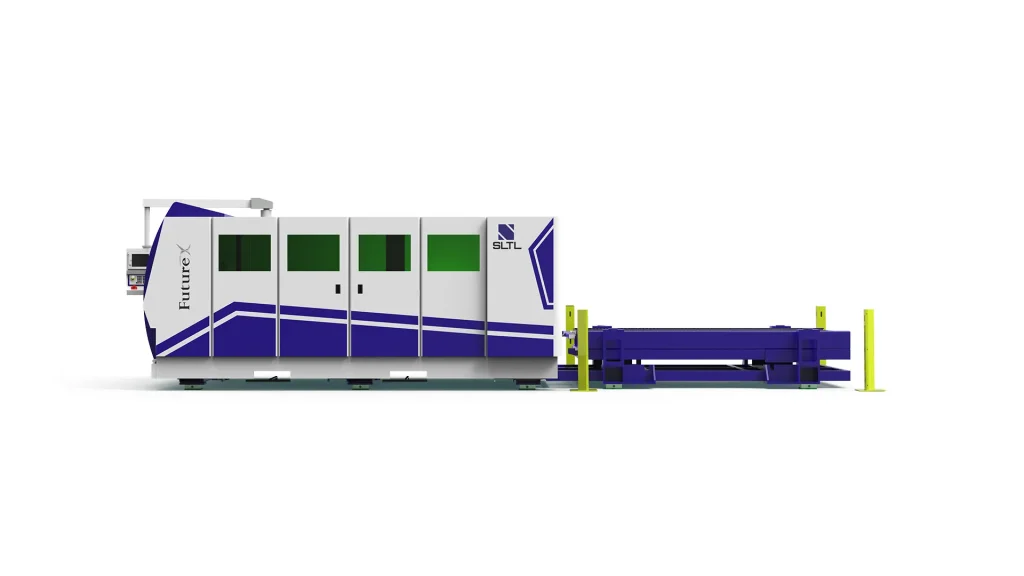
Future X – Advanced Aerospace Laser Cutting
The Future X is SLTL’s flagship precision laser cutting system, purpose-built for demanding aerospace applications. It combines a high-brightness fiber laser source with a fully enclosed, vibration-damped gantry structure and servo-driven linear axes for maximum accuracy.
Key specifications for sandwiched aluminium:
- Power range: 3 kW – 12 kW (scalable)
- Positioning accuracy: ±0.03 mm
- Repeatability: ±0.02 mm
- Cutting envelope: up to 3000 × 1500 mm standard; custom formats available
- Automatic focus control with real-time capacitive height sensing
- Nitrogen/oxygen/air assist gas with programmable pressure profiling
Aerospace fit: Fuselage skin panels, wing rib assemblies, nacelle structural sheets, complex contour cutting of aerospace blanks. The Future X is the recommended platform for Tier-1 aerospace OEM suppliers with AS9100D certification requirements.
Infinity F1 – Heavy-Duty High-Power Manufacturing
The Infinity F1 is engineered for high-volume, round-the-clock production environments where throughput and uptime are the primary metrics. With power options up to 15 kW and a reinforced machine bed designed for heavy aerospace panel formats, the Infinity F1 handles large sandwiched aluminium structures with consistent process stability.
Key specifications:
- Power range: 6 kW – 15 kW
- Maximum sheet size: 4000 × 2000 mm
- Dual-pallet exchange system for near-zero downtime
- Water-cooled laser source for sustained duty cycle
- Integrated smoke and fume extraction
Aerospace fit: Heavy aerospace structural panels, large cargo door liners, floor beam assemblies, and high-mix/high-volume aerospace aluminium fabrication lines. The Infinity F1 is the right choice when your production shift runs 18–24 hours continuously.
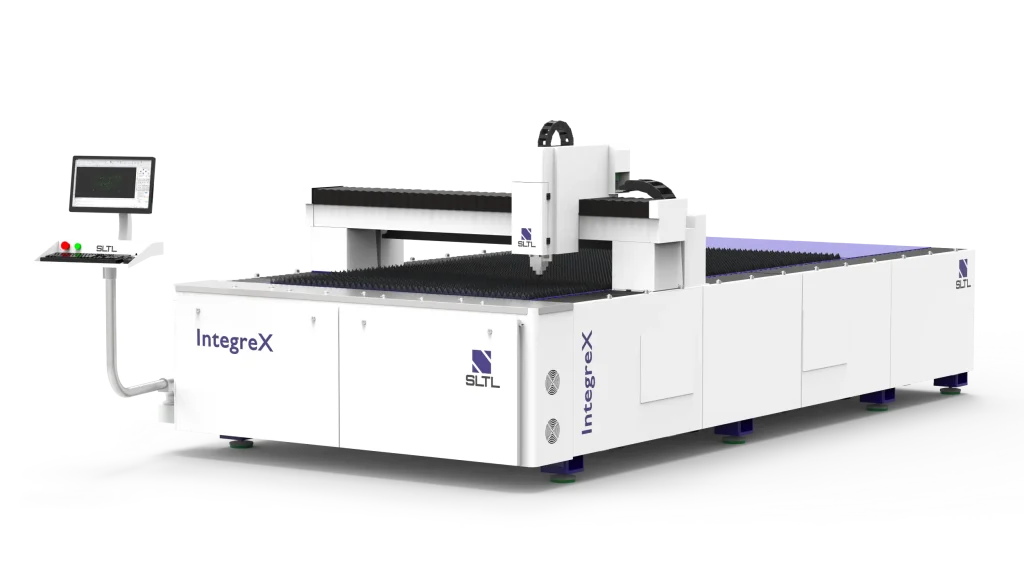
IntegreX -Affordable Productivity-Focused Cutting
The IntegreX delivers production-grade fiber laser performance in a compact, cost-efficient package ideal for aerospace Tier-2 and Tier-3 suppliers that need consistent precision without the capital outlay of a full flagship system.
Key specifications:
- Power range: 1.5 kW – 6 kW
- Positioning accuracy: ±0.05 mm
- Compact footprint for space-constrained facilities
- Compatible with SLTL’s advanced nesting software
- Single-table and exchange-table configurations
Aerospace fit: Aerospace bracket cutting, small panel components, prototype aerospace sheet processing, and component suppliers running mixed aerospace and general industrial work. The IntegreX is a strong entry point for suppliers scaling into aerospace production.
X5 -3D Laser Cutting Applications
The X5 is SLTL’s 5-axis 3D laser cutting platform, designed for aerospace components that cannot be processed on a flat-bed machine. It handles complex formed aluminium parts, hydroformed aerospace shells, and 3D-contoured sandwiched structures that require simultaneous multi-axis cutting.
Key specifications:
- 5-axis cutting head with ±135° tilt capability
- Compatible with formed and drawn aluminium parts up to 600 mm profile depth
- Seamless integration with CAD/CAM offline programming
- Applicable for trimming, hole piercing, and contour cutting on 3D aero-structures
Aerospace fit: Cockpit frame components, engine nacelle half-shells, formed fuselage doublers, structural reinforcement brackets, and any aerospace part requiring contour cutting after deep drawing or forming. If your parts are not flat, the X5 is your machine.
Integrated Aerospace Manufacturing Beyond Cutting
A complete aerospace production cell requires more than cutting. SLTL’s laser marking range integrates directly into your fabrication line to deliver AS9100D-compliant part identification, UID marking, and traceability at production speed.
SLTL Laser Marking Machines for Aerospace Applications
Aerospace traceability requires every component to be permanently identified with serial numbers, part numbers, manufacturer codes, material grades, and inspection stamps all compliant with ATA 2000, MIL-STD-130, and customer-specific UID requirements.
Nova
Compact fiber laser marking station. Ideal for aerospace name plate marking, small aluminium panels, and production batch coding. Fits inline with conveyor-based production.
REX
High-speed galvanometer scanning marker. Optimised for component identification on flat aluminium parts, fastener heads, and sub-assembly components. Cycle times under 3 seconds per part.
ELITE
Heavy-duty enclosed marking workstation with XY table. Suited for large aerospace panels and structural components requiring multi-zone marking and barcode/QR code generation for material traceability.
Flexy
Portable laser marking system. For in-situ marking on large airframe assemblies where the part cannot be moved to a marking station. Battery-optional configurations available.
NEO
Entry-level fiber laser marker for production coding and part numbering in Tier-2/3 supplier environments. Compact, reliable, and easy to integrate with existing production lines.
Ultra
High-power deep-engraving marker for permanent identification on heavy aluminium castings and machined aerospace parts. Achieves mark depths up to 0.5 mm for long-life traceability.
OptiFly
Purpose-designed for curved and contoured aerospace surfaces. The OptiFly’s automatic Z-axis compensation maintains consistent focus across radius changes — critical for marking on fuselage panels, cowlings, and formed structural parts.
Carbon
Specialised for composite and CFRP aerospace surfaces in mixed-material assemblies. Where sandwiched aluminium meets carbon fibre structures, the Carbon delivers clean, readable marks without surface damage.
How Aerospace Suppliers Can Improve Throughput and Quality
Purchasing the right machine is step one. Maximising its value requires the right production strategy.
Nesting Optimisation
Aerospace-grade aluminium alloys (6061-T6, 7075-T6, 2024-T3) are expensive. Nesting software that achieves 88–92% material utilisation can reduce raw material cost by 8–12% annually on high-volume lines. SLTL’s integrated nesting module supports grain-direction locking for aerospace tempered materials, remnant sheet libraries, and multi-job nesting.
Process Parameter Databases
Establish certified cut parameter sets for each material-thickness-grade combination your production uses. Store these in the machine’s parameter library and lock them against unauthorised changes. This ensures the same edge quality on part number 1 and part number 10,000.
Preventive Maintenance Scheduling
Fiber laser sources in continuous aerospace production should be serviced at:
- 500 hours: nozzle and ceramic inspection, focus lens cleaning
- 2,000 hours: collimator lens inspection, assist gas system check
- 5,000 hours: fiber connector inspection, servo drive calibration check
SLTL provides factory service programmes, remote diagnostic capability, and a 72-hour critical parts response for minimising unplanned downtime.
Tube Cutting Integration
Many aerospace assemblies combine sheet components with tubular structural elements spars, struts, and conduit frames. SLTL’s tube cutting configurations allow the same fiber laser platform to process both flat sheet and round/square/rectangular tube profiles, reducing the machine footprint and capital cost of a complete fabrication cell.
For more on this topic, see our detailed guide on Aerospace Laser Welding and Structural Joining — covering how SLTL’s welding solutions complement laser-cut aerospace components in final assembly.
Marking and Cutting on One Platform
Running marking operations on a separate standalone machine creates scheduling bottlenecks and adds handling steps. SLTL offers integrated cut-and-mark cell configurations where laser marking is performed as an automated post-cut step on the same pallet, with no re-fixturing.
See also: Aerospace Laser Marking for UID Compliance a technical guide covering ATA 2000 datamatrix marking, permanent identification standards, and machine selection for aerospace traceability.
Final Buying Checklist Before Investing in a Laser Cutting Machine
Use this checklist before issuing a purchase order or requesting a final quotation.
Technical Validation
- Machine positioning accuracy verified against your tightest aerospace tolerance
- Cut samples produced on your specific sandwiched aluminium grade and thickness
- HAZ width measured on cut samples and compared to specification limit
- Edge roughness (Ra) measured and documented
- Assist gas consumption rate confirmed and budgeted
- Maximum sheet size confirmed against your largest aerospace panel
Production Fit
- Cycle time per part calculated and validated against production target
- Nesting software trialled with actual production part library
- Automation level confirmed (manual load, semi-auto, fully automatic)
- Integration with your MES/ERP system confirmed
- Floor space and utility requirements (power, compressed air, chiller) verified
Compliance and Traceability
- Machine documentation package reviewed for AS9100D evidence support
- Cut parameter logging capability confirmed
- Marking system compatibility confirmed for your UID standard
Commercial and Support
- Total cost of ownership (TCO) calculated over 5 years (capital + consumables + service)
- Spare parts availability and lead time confirmed
- Training programme reviewed
- Remote diagnostic capability confirmed
- Reference customers in aerospace contacted for performance validation
Conclusion
Choosing a laser cutting machine for sandwiched aluminium sheets in aerospace manufacturing is not a decision to be made on headline specifications alone. The interaction between beam quality, assist gas management, thermal control, fixturing, and software integration determines whether your production line delivers aerospace-compliant parts at the throughput and cost your business requires.
SLTL’s range from the precision-focused Future X to the heavy-duty Infinity F1, the accessible IntegreX, and the 3D-capable X5 covers every aerospace production scenario, from prototype development to full-rate Tier-1 component manufacturing. Combined with SLTL’s integrated marking solutions (Nova, REX, ELITE, Flexy, NEO, Ultra, OptiFly, Carbon), you can build a complete, compliant, traceable aerospace fabrication cell from a single supplier.
Ready to evaluate your options? Request a production sample cut on your specific material, or speak with an SLTL aerospace application engineer to identify the exact configuration for your production requirements.
FAQs
Q1. What laser power is recommended for cutting sandwiched aluminium sheets in aerospace production? For sandwiched aluminium up to 15 mm total thickness, a 3–6 kW fiber laser is typically sufficient for production-rate cutting with acceptable edge quality. Sheets between 15–30 mm benefit from 6–12 kW sources. Always factor in the core material aluminium honeycomb cores require different power profiles than foam or adhesive-only cores, and your machine supplier should validate parameters on your specific material stack before finalising power selection.
Q2. How does a fiber laser minimise delamination when cutting layered aluminium structures? Delamination in sandwiched aluminium is primarily caused by excessive heat penetration into the adhesive or core layer. Fiber lasers minimise this risk through high peak power with short pulse durations (in pulsed modes), high-pressure nitrogen assist gas that immediately ejects melt from the kerf, and programmable feed rate modulation. Machines with automatic focus control also maintain consistent energy density through the full material depth, preventing hot spots that cause delamination.
Q3. Can SLTL laser cutting machines be integrated with automated aerospace production lines? Yes. SLTL’s Future X and Infinity F1 platforms support full automation integration including robotic loading/unloading, automated pallet exchange, OPC-UA communication for MES/ERP connectivity, and barcode/RFID-based part tracking. Integration design is available as part of SLTL’s application engineering support for aerospace customers.
Q4. What edge quality can I expect on aluminium sheet cutting for aerospace applications? On aerospace-grade aluminium (6061-T6, 7075-T6) with optimised fiber laser parameters and nitrogen assist gas, typical edge roughness (Ra) values are 1.6–3.2 µm, with HAZ widths of 0.1–0.3 mm. Cut perpendicularity is typically within 0.05 mm over a 10 mm material thickness. These values are achievable on SLTL machines and should be validated on production samples before finalising machine selection.
Q5. Which SLTL laser marking machine is compatible with aerospace UID requirements? All SLTL marking machines (Nova, REX, ELITE, Ultra, OptiFly, and others) can produce UID-compliant datamatrix codes and alphanumeric identifiers meeting ATA 2000 and MIL-STD-130N requirements. For curved aerospace surfaces, the OptiFly with automatic Z-axis compensation is recommended. For composite and mixed-material assemblies, the Carbon is the appropriate choice. SLTL’s marking systems produce marks that meet both human-readable and machine-readable requirements for aerospace traceability audits.
Q6. What is the typical ROI period for a laser cutting machine investment in aerospace fabrication? ROI varies by production volume, current process cost, and machine utilisation rate. In typical aerospace sheet metal fabrication environments replacing waterjet or mechanical routing, laser cutting delivers ROI within 18–36 months through reduced per-part cycle time (typically 3–5× faster), lower tooling and consumable cost, reduced secondary finishing labour, and improved material yield through nesting optimisation. SLTL can provide a site-specific ROI model based on your production data.
Q7. Does SLTL provide on-site training and commissioning support for aerospace customers? Yes. All SLTL machine installations include on-site commissioning, operator training, and application parameter development for your specific materials. Aerospace customers additionally receive documentation support for their AS9100D quality management system, including process validation records and machine capability assessments. Ongoing support is available through SLTL’s regional service network and remote diagnostic platform.