
Aerospace manufacturing requires an uncompromising approach to structural integrity, weight reduction, and component longevity. As Tier 1 and Tier 2 suppliers transition away from heavy mechanical fasteners and traditional TIG welding, advanced laser processing has emerged as the industry standard. Utilizing a dedicated system allows production lines to achieve high-vacuum sealing, exceptional clean weld quality, and near-zero thermal distortion.
For engineers and operations managers evaluating advanced joining technologies, integrating a high-precision laser welding machine into your workflow resolves the persistent challenges of joining thin-walled components and exotic alloys. This supporting article explores how deep-penetration laser welding optimizes production, and how it pairs alongside advanced cutting and marking workflows to establish total manufacturing traceability.
For the full context on precision requirements across aerospace laser processing, read our pillar guide: Why Aerospace Manufacturers Need High-Accuracy Laser Processing covering tolerancing, compliance, and the production case for laser-based aerospace fabrication.
Why Aerospace Assemblies Need Precision Laser Welding
Traditional fusion welding methods introduce massive thermal energy into the substrate. This extended Heat-Affected Zone (HAZ)the area where the metal’s microstructure is altered by heat—compromises the grain structure of specialized aerospace metals, inducing residual stresses, micro-cracking, and macroscopic geometric warping. In an industry where components must withstand extreme pressure differentials and cyclic thermal loading, conventional structural vulnerabilities are non-negotiable.
Precision laser welding utilizes a highly concentrated, coherent light beam to deliver localized energy exactly at the joint interface. By executing the weld at high speeds, the energy is dissipated before it can migrate into the surrounding substrate. This localized thermal management makes it the premier choice for critical aerospace assemblies that require strict dimensional repeatability without post-weld straightening processes.
Benefits of Laser Welding Machines in Aerospace Manufacturing
Deploying an industrial laser welding machine on your fabrication floor provides distinct structural and financial advantages over manual arc processing:
- Minimizing the Heat-Affected Zone (HAZ): Localized thermal input preserves the temper, mechanical properties, and grain structure of high-performance base metals.
- Deep, Narrow Weld Profiles: High aspect-ratio keyhole welding allows deep joint penetration with minimal surface bead width, decreasing the need for secondary grinding or finishing operations.
- Hermetic and High-Vacuum Sealing: Precise control over beam modulation eliminates porosity, producing leak-proof, hermetic joints for sensor housings and complex fluid lines.
- Flawless Clean Weld Quality: The non-contact nature of laser processing eliminates electrode contamination, ensuring pristine, radiography-grade joints that pass stringent non-destructive testing (NDT).
How Laser Welding Reduces Distortion in Aerospace Components
Weight optimization drives aerospace design. Engineers routinely utilize thin-wall assemblies, honeycombs, and sandwiched structures to shed weight without sacrificing structural safety. However, welding thin-gauge materials like 0.5 mm sheets using traditional methods almost always results in buckling or burn-through.
Laser processing eliminates this issue. The high power density allows for instant material wet-out and fast travel speeds, constraining thermal expansion. Whether assembling sensitive sensor housings, intricate fuel system components, or delicate thin-wall assemblies, a dedicated aerospace laser welding setup guarantees structural alignment within micron-level tolerances.
Precision Welding for Lightweight Aerospace Structures
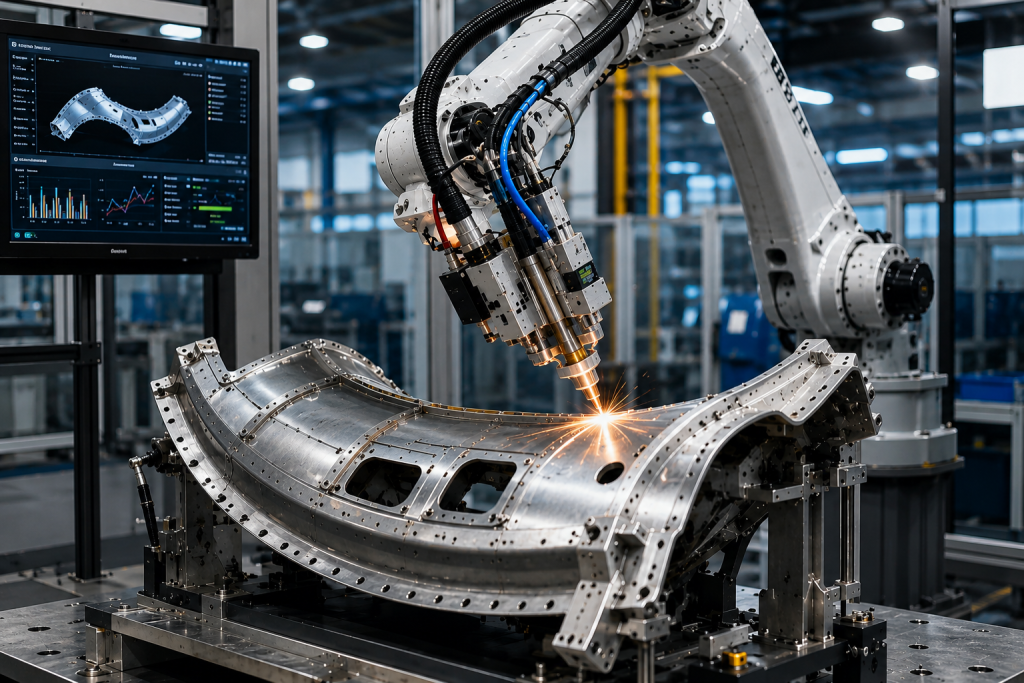
Robotic Laser Welding Visual Context
To understand how automated laser systems navigate complex 3D aerospace profiles, examine the deployment configuration of high-accuracy robotic processing cells below. Note how the articulated head delivers constant energy density across varying contours.
Aerospace Materials Suitable for Laser Welding
Aerospace metallurgy relies on high strength-to-weight ratios and exceptional thermal resistance. Laser systems excel at joining these traditionally difficult-to-weld materials:
- Titanium Alloys (Ti-6Al-4V): Vital for titanium assemblies and aircraft frames. Laser welding prevents atmospheric contamination when properly shielded, maintaining titanium’s native ductility and fatigue resistance.
- Aerospace-Grade Aluminium (2xxx, 6xxx, 7xxx Series): Extensively used in aluminium structural parts. The high energy density of the laser overcomes the high thermal conductivity and reflectivity of aluminium, suppressing hot cracking.
- Superalloys (Inconel, Hastelloy): Found in turbine-related precision components. Laser processing successfully manages these crack-sensitive materials without altering their high-temperature creep performance.
Combining Cutting, Welding, and Marking in Aerospace Production
Modern manufacturing facilities no longer look at production processes in isolation. To achieve true factory floor efficiency, Tier 1 manufacturers combine multiple laser processes into single, seamless production streams.
For instance, a component’s lifecycle frequently begins with high-tolerance sandwiched aluminium sheet cutting or complex tube cutting. Once the pieces are sectioned, they move directly to an automated precision welding cell to form the final structure. Finally, the assembly passes through a laser marker to perform durable name plate marking and 2D/3D marking directly onto the metal surface.
This cell-based, unified laser processing workflow reduces material handling, guarantees part alignment, and streamlines part verification.
SLTL Laser Solutions for Aerospace Precision Assemblies
Sahajanand Laser Technology Limited (SLTL Group) provides integrated, turnkey laser systems optimized for the rigorous demands of aerospace contract manufacturing. Rather than treating welding as an isolated step, SLTL delivers end-to-end multi-process ecosystems where cutting, welding, and marking coexist within a unified quality workflow.
High-Precision Cutting Solutions
Before components reach the welding stage, they require flawless edge preparation. SLTL’s advanced cutting line delivers distortion-free, weld-ready edges:
- Future X: The most advanced laser cutting solution equipped with advanced manufacturing features and real-time beam manipulation for intricate geometries.
- Infinity F1: A heavy-duty high-power laser cutting machine built to handle thick structural plates and robust aerospace components with clean edge finishes.
- IntegreX: An affordable lower-power laser cutting machine designed for productivity and efficiency without compromising linear accuracy.
- X5: A specialized 3D laser cutting machine designed for cutting complex curved profiles, hydroformed panels, and precise tube configurations.
Total Traceability via Laser Marking
Aerospace regulations demand complete lifetime component traceability. SLTL provides an extensive array of marking systems to etch durable, high-contrast parts identifiers, data matrices, and asset tags onto brackets and housings:
- Nova: A 200–500W customized laser marking solution designed for heavy-duty, high-contrast industrial component engraving.
- REX: A specialized diode laser system for traceability marking with highly controlled thermal outputs to protect underlying grain structures.
- ELITE: An ultra-precise fiber laser hallmarking solution optimized for delicate, thin-walled aerospace electronics and fine detailed etching.
- Flexy: A unique movable diode laser marker designed for difficult-to-reach aerospace parts on large, heavy structural frames.
- NEO: A multipurpose high-power fiber laser marking machine (20–60W) that handles both deep engraving and high-speed surface annealing.
- Ultra: A low-power fiber laser marking machine (20–120W) tailored for consistent day-to-day part identification workflows.
- OptiFly & Carbon: CO2 laser marking solutions engineered specifically for fast plastic marking, composite cutting cleanups, and mass production engraving.
- ENZO: A fully customized laser marking solution up to 200W capable of dropping directly into fast-moving, high-mix automated production lines.
Choosing the Right Machine
Selecting the ideal equipment requires evaluating your production volume, material thickness, and structural geometry. For flat, sheet-metal intensive parts, a standard 2D laser welding gantry provides excellent processing speeds. For complex, non-linear geometries such as multi-axis aerospace brackets or curved engine cowlings an articulated robotic arm equipped with a fiber-delivered laser head provides the needed physical reach.
Additionally, operators must consider the integration of localized shielding gas delivery systems to completely insulate the melt pool from oxygen embrittlement during processing.
Accelerate Your Aerospace Production
Overcoming production bottlenecks, reducing weld rejection rates, and mastering tight tolerances requires a dedicated manufacturing partner. SLTL Group combines decades of laser engineering expertise with deep industrial insight to build production systems suited for modern aerospace standards.
Contact our technical consulting team today to discuss your precision manufacturing challenges, request a comprehensive application assessment, or schedule a live system demonstration at our advanced technology center.
FAQs
Q1: How does a laser welding machine drastically reduce heat distortion in thin-walled aerospace assemblies?
Laser welding focuses a high power density onto a micro-sized spot, achieving rapid melting and cooling cycles. Because the travel speed is high, the overall thermal energy has no time to migrate into the surrounding substrate. This keeps the Heat-Affected Zone (HAZ) exceptionally small, preventing the buckling, warping, and residual stresses common in thin-walled components.
Q2: Can laser welding pass standard aerospace radiography and non-destructive testing (NDT)?
Yes. Because laser welding is a non-contact process, it eliminates electrode contamination risks associated with TIG/MIG welding. When paired with correct shielding gas mechanics and optimized pulse modulation, it eliminates porosity and micro-fissures, consistently yielding radiography-grade welds that pass stringent aerospace validation.
Q3: Which aerospace-grade aluminum and titanium alloys are compatible with SLTL laser systems?
SLTL laser welding systems are fully optimized for crack-sensitive materials including Titanium alloys (such as Ti-6Al-4V), structural aerospace aluminum series (2xxx, 6xxx, and 7xxx), and high-temperature nickel superalloys like Inconel. The highly controlled energy profile prevents elemental burn-out and hot-cracking in these sensitive metals.
Q4: How easily can traceability marking systems be integrated directly into a laser welding production line?
SLTL architecture is designed for modular integration. Marking systems like the SLTL Nova, NEO, or REX can be mounted directly into automated robotic welding enclosures or configured as sequential stations managed by a centralized PLC, allowing automated marking of tracking codes directly after the joining process is completed.
Q5: What are the maintenance and operational lifespan expectations for industrial fiber laser welding heads?
Modern solid-state fiber laser sources are highly durable, often exceeding 100,000 hours of operational life. Maintenance is primarily restricted to checking consumable protective cover slides, ensuring clean optical paths, and maintaining the closed-loop water chiller unit, resulting in significantly lower downtime compared to traditional automated arc setups.
Q6: Can SLTL laser welding systems accommodate low-volume, high-mix component manufacturing?
Absolutely. By utilizing programmable CNC paths and adaptable robotic trajectories, changing production from a run of sensor housings to large aerospace brackets requires only a software recipe change and quick-change fixture repositioning, maximizing floor utilization.