
When aerospace manufacturers work with laser cutting sandwiched aluminium sheets, precision is not optional -it is a structural requirement. Layered aluminium structures are widely used across aerospace parts manufacturing because they offer an ideal balance of lightweight properties and mechanical strength. However, cutting these multi-layer sheets without introducing delamination, burrs, or thermal distortion demands far more than conventional machining. Modern laser cutting machines have emerged as the most reliable solution for sandwiched aluminium cutting, delivering the edge quality, speed, and repeatability that aerospace-grade components demand.
This blog explores how laser cutting technology addresses the unique challenges of processing sandwiched aluminium, and why it has become a cornerstone of advanced aerospace fabrication workflows. If you want a broader understanding of why precision matters across all laser-based operations in this sector, read our pillar blog: Why Aerospace Manufacturers Need High-Accuracy Laser Processing.
What Are Sandwiched Aluminium Sheets?
Sandwiched aluminium sheets – also called aluminium composite panels or layered aluminium structures – consist of two or more aluminium face sheets bonded with a core material. Common core options include:
- Polyethylene (PE) core– lightweight, used in interior aerospace panels
- Aluminium honeycomb core– high stiffness-to-weight ratio for structural applications
- Mineral or fire-retardant core – used where safety ratings are critical
- Foam core -for thermal and acoustic insulation requirements
These multi-layer configurations give aerospace engineers the ability to design parts that are simultaneously rigid, lightweight, and thermally stable. You will find sandwiched aluminium in aircraft fuselage panels, interior cabin liners, floor panels, cargo hold walls, satellite structural components, and drone body frames.
The combination of dissimilar materials within a single sheet is what makes cutting so technically demanding. Each layer responds differently to heat and mechanical force, which is why traditional routing, shearing, or saw-cutting often leads to edge delamination and unacceptable tolerances.
Challenges in Cutting Layered Aluminium Structures
Processing sandwiched aluminium introduces a set of challenges that directly affect part quality and production efficiency.
Delamination risk: When the core and face sheets are cut with mechanical tools, shear forces can cause the bonded layers to separate at the edges. In aerospace applications, delaminated edges can compromise structural integrity and fail quality inspection.
Heat affected zone (HAZ) control: Aluminium is highly conductive. During any thermal cutting process, heat spreads rapidly into the surrounding material. With sandwiched structures, excessive heat can melt or degrade the core material- particularly polymer or foam cores- even when the aluminium face sheets appear undamaged.
Burr formation: Conventional cutting leaves burrs on aluminium edges that require secondary deburring operations. In aerospace parts manufacturing, this adds time, cost, and the risk of introducing dimensional variation through manual finishing.
Tolerance requirements: Aerospace-grade components are held to extremely tight dimensional tolerances. Any process that introduces positional drift, kerf variation, or edge irregularity creates rework costs and potential non-conformance.
Multi-layer complexity: A tool that performs well on a single aluminium sheet may behave unpredictably when cutting through layers with different thermal and mechanical properties.
These challenges are precisely where laser cutting machines demonstrate clear advantages over traditional methods.
Why Laser Cutting Is Ideal for Sandwiched Aluminium Cutting
Laser cutting addresses the core challenges of sandwiched aluminium processing through precise energy delivery, non-contact cutting, and programmable parameters that can be fine-tuned for different layer configurations.
Heat Affected Zone Control
A high-quality laser cutting machine focuses energy into an extremely narrow beam, concentrating thermal input to the cut zone only. With correct power settings, cut speed, and assist gas selection- typically nitrogen for aluminium – the HAZ is reduced to a fraction of a millimetre. This protects polymer or honeycomb cores from thermal degradation while maintaining clean, oxidation-free edges on the aluminium face sheets.
Burr-Free Cutting
Fibre laser systems operating with optimised parameters produce near-burr-free edges on aluminium, eliminating the need for secondary deburring in most cases. This is particularly valuable in aerospace parts manufacturing, where every additional process step introduces cost, time, and risk.
Precision Edge Quality
Laser cutting delivers consistent kerf widths and sharp, clean edges across the full length of a cut. For sandwiched aluminium, this means the face sheets and core are cut simultaneously without step deviation between layers. The result is a straight, smooth edge that meets aerospace tolerances directly off the machine.
Multi-Layer Processing Capability
Modern fibre laser systems can be configured to cut through multi-layer aluminium stacks effectively. By adjusting power, frequency, and gas pressure, operators can control how energy is distributed through the thickness of the material -managing the transition between face sheets and core without compromising either layer.
Speed and Repeatability
Laser cutting machines offer high-speed processing with CNC-driven repeatability. Once a cutting programme is validated for a specific sandwiched aluminium configuration, every subsequent part is produced to the same standard without operator-dependent variability. This is essential for aerospace production environments where traceability and consistency are mandatory.
Reduced Material Wastage
The narrow kerf of a laser cut -typically 0.1 to 0.3 mm for aluminium -means minimal material is removed per cut. Nesting software further optimises sheet utilisation, reducing the cost of aerospace-grade aluminium panels.
Applications in Aerospace Parts Manufacturing
Laser cutting is used across a wide range of aerospace manufacturing tasks that involve sandwiched aluminium and related materials.
Sandwiched aluminium sheet cutting: Fuselage panels, access doors, cargo floor panels, and cabin liner sections are cut to shape with dimensional accuracy that supports direct assembly without additional machining.
Tube cutting: Structural aluminium tubes used in aerospace frames and support structures are cut with laser tube-cutting systems, enabling complex angle cuts, notches, and end profiling with high accuracy.
2D and 3D marking: Component identification, serial numbers, part codes, and inspection markings are applied directly to aluminium surfaces using laser marking. This eliminates adhesive labels and ensures permanent traceability- a requirement in aerospace quality management systems.
Composite cutting: Fibre-reinforced composite panels that accompany sandwiched aluminium in aerospace assemblies can also be processed on multi-format laser platforms, simplifying the cutting cell footprint.
Name plate and data plate marking: Regulatory data plates for aircraft components are laser-marked with permanent, high-contrast text and barcodes directly onto aluminium substrates, meeting aviation authority marking standards.
For a detailed look at how laser systems support broader aerospace fabrication requirements, including material qualification and process documentation, read our related blog: Laser Processing Solutions for Aerospace Composite and Aluminium Fabrication.
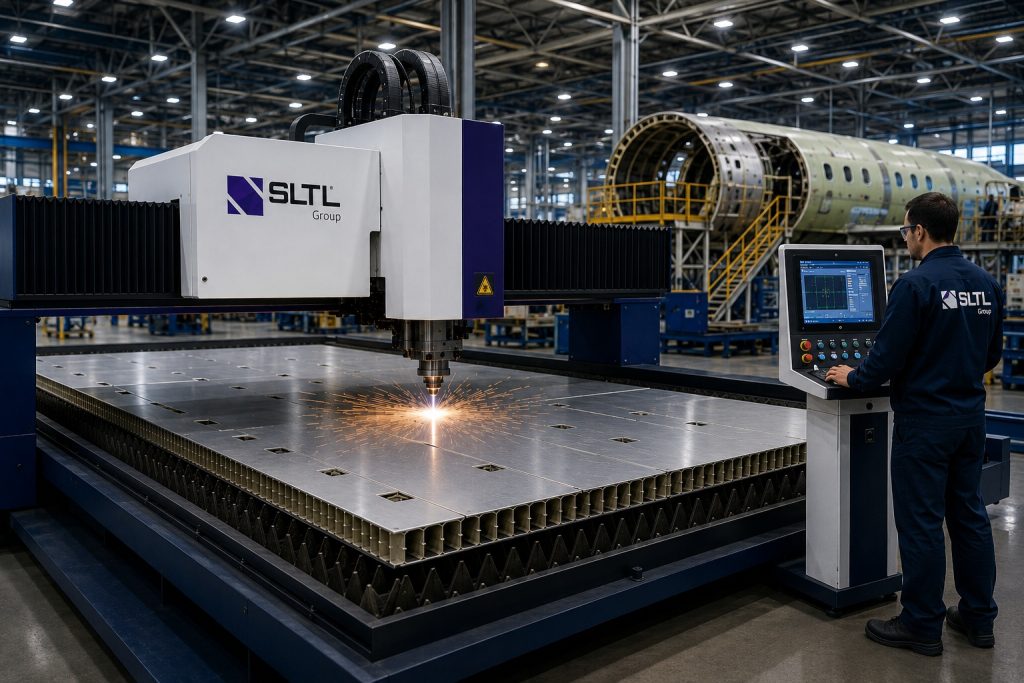
Best SLTL Laser Machines for Aerospace Sheet Processing
SLTL Group offers a purpose-built range of laser cutting, welding, and marking machines designed for the demands of aerospace and industrial fabrication. Each machine is engineered to specific performance parameters that align with different aerospace production requirements.
Future X -Most Advanced Laser Cutting Solution
The Future X is SLTL’s flagship laser cutting machine for high-precision manufacturing. Equipped with advanced automation and smart manufacturing features, it is built for aerospace environments where repeatability, process documentation, and high-volume throughput are non-negotiable. The Future X handles sandwiched aluminium sheet cutting with precise HAZ control and supports integration with digital manufacturing workflows. For aerospace manufacturers scaling up precision production, this is the most advanced laser cutting solution in the SLTL range.
Infinity F1 -Heavy-Duty Thick Aluminium Processing
The Infinity F1 is designed for heavy-duty manufacturing environments requiring thick aluminium sheet processing. With high-power laser cutting capabilities, it processes the full range of aerospace structural panel thicknesses without compromising edge quality or cut speed. The Infinity F1 is the right choice when production volumes are high and material thickness demands maximum laser power.
IntegreX – Cost-Effective Productivity for Medium-Scale Operations
The IntegreX brings precision laser cutting capability to medium-scale aerospace fabrication operations. It is a cost-effective productivity solution that delivers lower-power precision cutting suitable for thinner sandwiched aluminium panels, interior aerospace components, and prototype fabrication. For fabrication companies that need aerospace-grade accuracy without enterprise-scale capital investment, the IntegreX is the practical choice.
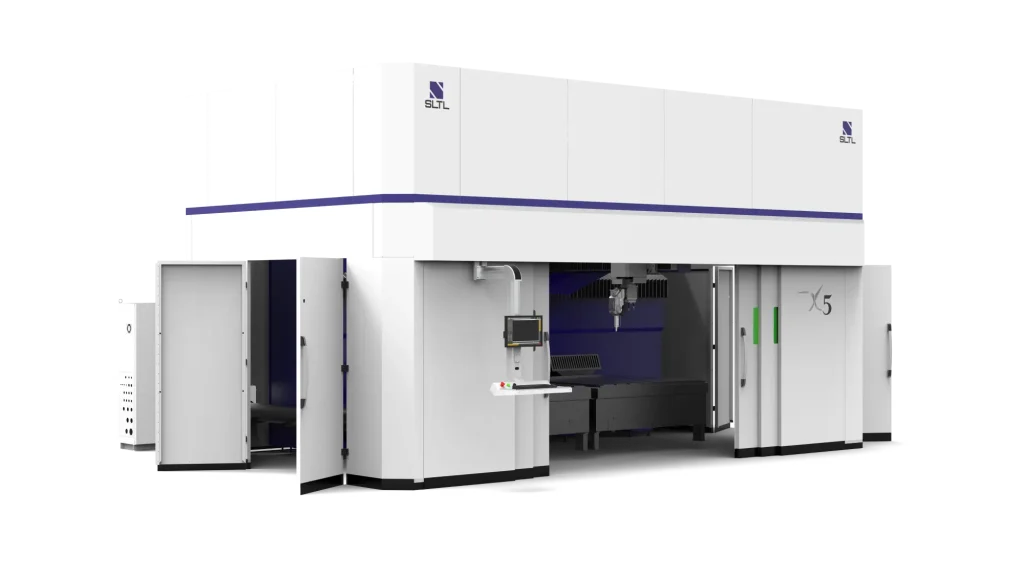
X5 — Specialised 3D Laser Cutting for Complex Geometries
The X5 is SLTL’s specialised 3D cutting machine, designed for complex aerospace geometries that cannot be achieved on a standard flatbed system. It enables full 3D aerospace component cutting — including trimming of formed panels, cutting compound-angle flanges, and processing near-net-shape aerospace parts directly after forming. When a sandwiched aluminium component has been hydroformed or press-formed, the X5 handles the subsequent precision trim operation with accuracy.
Nova — Precision Laser Welding for Aerospace Assemblies
Not all aerospace laser processing is about cutting. The Nova delivers 200–500W customised laser welding for aerospace assemblies where joining sandwiched aluminium panels or attaching fittings requires the same precision as the cutting process. Nova’s welding parameters are optimised for aerospace aluminium alloys, producing consistent, low-distortion welds that meet structural requirements.
ENZO -Fine Micro Welding Applications
The ENZO provides up to 200W precision welding for fine micro welding applications in aerospace manufacturing – including thin-gauge aluminium components, sensor housings, electronic enclosures, and precision instrument parts. Where joint quality and minimal thermal influence are critical, the ENZO delivers controlled, repeatable micro welds.
Future of Aerospace Composite and Aluminium Processing
The trajectory of aerospace manufacturing points clearly toward greater use of multi-material, lightweight structures and laser technology is evolving alongside this shift.
Automation integration: Laser cutting machines are increasingly paired with robotic loading/unloading systems and automated nesting software, reducing labour dependency and enabling lights-out manufacturing for high-volume aerospace programmes.
Hybrid processing: Future platforms are combining laser cutting, laser welding, and laser marking in single-setup cells, allowing aerospace fabricators to process a sandwiched aluminium panel from raw sheet to marked, inspected part without re-fixturing.
AI-assisted parameter optimisation: Machine learning applications are being developed to automatically adjust laser parameters based on material lot variation, reducing the time needed to qualify new sandwiched aluminium configurations.
Tighter integration with digital twin environments: Laser cutting systems are beginning to feed real-time process data back into aerospace quality management systems, supporting the full traceability requirements of aviation authorities.
For aerospace manufacturers, investing in high-accuracy laser processing now means building a manufacturing infrastructure that is ready for next-generation aircraft programmes. Understand the complete picture by reading: Why Aerospace Manufacturers Need High-Accuracy Laser Processing.
Call to Action
Ready to Upgrade Your Aerospace Laser Processing Capability?
Whether you need to cut sandwiched aluminium panels at high speed, weld precision aerospace assemblies, or mark components to aviation traceability standards, SLTL has a laser solution engineered for your requirement.
- 🔹 Explore the full range of SLTL aerospace laser cutting machines
- 🔹 Request a demo of sandwiched aluminium cutting on your specific material configuration
- 🔹 Consult our aerospace laser processing specialists for a production-matched machine recommendation
Frequently Asked Questions
1. What is the best laser cutting machine for cutting aerospace aluminium? For high-volume aerospace production, the SLTL Future X offers the most advanced automation and precision. For thick aluminium panels, the Infinity F1 provides high-power cutting capability. Medium-scale operations benefit from the cost-effective IntegreX.
2. Can a laser cutting machine cut layered or sandwiched aluminium sheets? Yes. Fibre laser cutting machines are well-suited for sandwiched aluminium cutting when parameters are correctly configured. The key is controlling power, speed, and assist gas pressure to manage how the beam interacts with each layer – including the core material.
3. How accurate is laser cutting for aerospace-grade aluminium components? Modern fibre laser cutting systems achieve positional accuracies of ±0.03 mm to ±0.05 mm, which meets the tolerance requirements of most aerospace structural and interior components. CNC-driven repeatability ensures consistent results across production batches.
4. Does laser cutting produce burr-free edges on aluminium? With correctly optimised cutting parameters and nitrogen assist gas, fibre laser systems produce near-burr-free edges on aluminium -including sandwiched sheet configurations. This significantly reduces or eliminates the need for secondary deburring operations.
5. What thicknesses of sandwiched aluminium can a laser machine process? Entry-level laser cutting machines typically handle sandwiched aluminium panels up to 6–8 mm total thickness. High-power systems like the SLTL Infinity F1 can process thicker configurations. The core material type also influences the achievable thickness range.
6. What are the 3D laser cutting applications in aerospace manufacturing? The SLTL X5 handles 3D laser cutting for trimming formed panels, cutting flanges on press-formed components, profiling near-net-shape parts, and processing complex aerospace geometries that cannot be completed on a flat-bed system.
7. How does automation improve laser cutting for aerospace production? Automated laser cutting systems reduce operator dependency, improve repeatability, enable faster changeover between part programmes, and support lights-out manufacturing during high-volume production runs. SLTL’s Future X includes smart manufacturing features that integrate with digital production workflows.