
Aerospace manufacturing leaves no room for ambiguity. Every component that enters a flight-critical assembly from turbine brackets and hydraulic fittings to structural ribs and avionics housings must be traceable from raw material to retirement. Laser marking for aerospace traceability has become the standard method manufacturers rely on to meet this demand: it delivers permanent, machine-readable identification directly on the part, without compromising the material’s integrity or dimensional tolerance.
This blog explains why traceability requirements are non-negotiable in aerospace, how laser marking supports compliance across major standards, which component types require permanent identification, and which SLTL laser marking machines are best suited for each application.
Why Aerospace Traceability Is Critical
In aerospace, a single unidentified or misidentified component can trigger a cascade of consequences grounded fleets, regulatory investigations, or worse. Traceability is the system that prevents this. It creates an unbroken chain of identity from the supplier’s raw material certificate through machining, assembly, maintenance, and eventual decommissioning.
Regulatory frameworks make this mandatory. Standards such as AS9100, AMS 2816, MIL-STD-130, and EASA Part 21 require that aerospace parts carry permanent, legible identification that survives the full service life of the component. This includes:
- Serial numbers for individual part tracking
- Part numbers linking components to drawings and specifications
- Lot/batch codes enabling batch-level recall and quality control
- Date codes recording manufacture or inspection dates
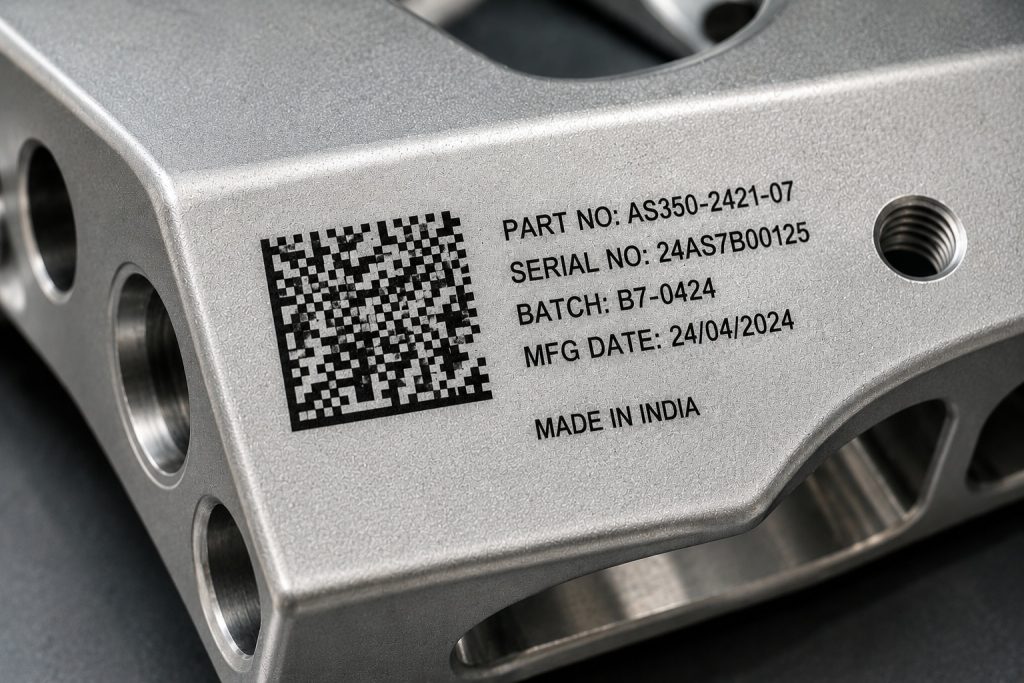
- Data Matrix or QR codes for machine-readable, compact encoding of full traceability data
When a maintenance event occurs scheduled inspection, component replacement, or incident investigation technicians and MRO (maintenance, repair, and overhaul) teams rely entirely on this marking to pull the part’s history, verify its certification status, and confirm it belongs in that assembly.
Without reliable part marking, audits stall, supply chains break down, and manufacturers face potential non-conformance findings that can halt production lines.
How Laser Marking Supports Aerospace Compliance
Traditional marking methods inkjet printing, mechanical stamping, chemical etching each carry limitations in an aerospace context. Ink degrades under extreme thermal cycling, UV exposure, and cleaning solvents. Stamping creates stress risers that can initiate fatigue cracks in high-cycle structural components. Chemical etching requires hazardous material handling and produces inconsistent depth.
Laser marking addresses all of these concerns. The process uses a focused beam to alter the surface of the material through annealing, ablation, engraving, or foaming without contact, without consumables, and without introducing mechanical stress. The result is a mark that is:
- Permanent integrated into the material surface, not applied on top of it
- Dimensionally stable no raised or recessed geometry that affects fit or function
- Chemically resistant unaffected by aviation fuels, hydraulic fluids, and cleaning agents
- Readable by automated vision systems critical for MES and ERP integration on high-volume lines
For aerospace manufacturers working toward high-accuracy laser processing across cutting, welding, and marking operations, laser marking forms the traceability backbone that connects every downstream process to its originating specification.
Compliance is not only about the mark surviving — it is about the mark being verifiable. Data Matrix codes marked by fiber laser systems achieve Grade A verification under ISO/IEC 15415, the standard used to assess 2D symbol quality. This grade is increasingly required by Tier 1 OEMs and defence contractors when submitting part documentation.
Aerospace Components That Require Permanent Part Marking
The scope of part marking in aerospace spans the entire aircraft structure and its systems. The following component categories typically mandate permanent identification:
Structural Components Aluminium aerospace brackets, wing ribs, fuselage frames, and sandwich aluminium sheet assemblies require serial marking that survives decades of thermal and mechanical stress. Laser engraving on aluminium alloys (6061, 7075, 2024) provides high-contrast marks without affecting the anodised or primed surface coating outside the mark boundary.
Engine and Turbine Hardware Turbine blades, compressor discs, and combustor housings operate in environments of extreme heat and oxidation. These components are typically marked with low-stress laser annealing or electrochemical-resistant laser engraving that meets the manufacturer’s stress-sensitive requirements.
Tubing and Hydraulic Lines Aerospace tube cutting produces components that must carry traceability marking on their outer diameter often in tight circumferential geometries. Rotary fixtures or galvo-head positioning allow laser marking systems to place serial codes around curved tube surfaces without distortion.
Fasteners and Connectors High-strength fasteners, bolts, and electrical connector bodies carry part numbers and lot codes in extremely confined areas. Fiber laser marking systems with small spot sizes (down to 20 µm) can mark on surfaces as small as a few millimetres.
Composite and Plastic Housings CFRP panels, fibreglass enclosures, and thermoset composite structures used in avionics bays and interior structures require marking without ablating reinforcing fibres. CO2 laser systems are optimised for this application, producing clean surface marks on polymer matrix composites.
Name Plates and Rating Plates Metallic name plates mounted on engines, APUs, landing gear, and ground support equipment carry permanent laser-marked identification that must remain legible for 20–30 year service lives.
Benefits of Laser Marking Machines in Aerospace Manufacturing
Aerospace manufacturers evaluating marking technologies consistently identify laser systems as the best-fit solution for their traceability requirements. The core advantages are practical and measurable:
No consumables, no recurring costs. Unlike inkjet or dot-peen systems, laser marking machines require no inks, ribbons, or replacement tips. Operating cost over a 5–10 year production horizon is substantially lower.
Process integration. Modern laser marking machines can be triggered directly by MES or ERP systems via serial, USB, or Ethernet interfaces. Part data serial numbers, batch codes, date stamps flows automatically from the production database to the marking controller, eliminating manual data entry errors.
Repeatability at production scale. Laser marking is a non-contact, deterministic process. The same marking parameters produce the same result on part number 1 and part number 100,000. This is critical for automated vision-based barcode verification downstream.
Multi-material capability. A single fiber laser marking machine can mark aluminium alloys, titanium, stainless steel, Inconel, and anodised surfaces the full range of aerospace metallic substrates without tooling changes.
Compact footprint. Benchtop and enclosure-mounted laser marking stations can be installed directly at machining cells or assembly lines, marking parts immediately after processing without a secondary handling step.
2D and 3D Laser Marking Applications in Aerospace
2D Marking
Two-dimensional Data Matrix codes are the dominant machine-readable format in aerospace traceability, used across MIL-STD-130 and ATA Spec 2000 compliant programmes. A single Data Matrix code measuring 5 × 5 mm can encode a full part number, serial number, cage code, and manufacturing date in a format readable by handheld scanners and automated camera systems.
Fiber laser marking machines particularly those in the 20–60W power range achieve the fine resolution needed for high-density Data Matrix cells at small symbol sizes. The mark quality, when verified against ISO 15415, must meet the minimum grade specified in the programme’s quality plan.
QR codes are used where larger data payloads are required for example, encoding a URL pointing to the part’s digital logbook or certification record in a cloud-based traceability system.
3D Laser Marking
Not all aerospace surfaces are flat. Cylindrical shafts, compound-curved castings, inlet cowlings, and structural forgings present three-dimensional surfaces that defeat conventional flat-bed marking. 3D laser marking uses dynamic focus control and multi-axis beam steering to maintain consistent mark depth and cell size across varying Z-heights.
This is particularly relevant for aerospace tube marking, curved structural members, and rotary components where the marking area follows a non-planar profile. For manufacturers already investing in 3D laser cutting for complex aerospace geometries, 3D marking on the same component family is a natural process extension.
SLTL Laser Solutions for Aerospace Traceability
SLTL offers a structured range of laser marking and cutting machines designed for aerospace manufacturing environments. The right system depends on the substrate, component geometry, marking resolution, and throughput requirements.
Laser Marking Machines
ELITE – Fiber Laser Marking Machine The ELITE is SLTL’s primary recommendation for precision aerospace traceability marking on metallic substrates. Its fiber laser source delivers the beam quality needed for fine Data Matrix cells, serial number engraving on aluminium alloys, and high-contrast marking on anodised and painted surfaces. Best suited for: aluminium brackets, name plates, fastener identification, and QR/Data Matrix marking on flat and near-flat surfaces.
NEO – Fiber Multipurpose High-Power Marking Machine (20–60W) The NEO handles higher-power requirements for deeper engraving on hard alloys, thick oxide layers, and high-cycle-count marking stations. Its power range covers both light surface annealing and aggressive depth engraving, making it versatile across the range of aerospace metallic substrates.
Ultra – Fiber Multipurpose Low-Power Marking Machine (20–120W) The Ultra’s broad power range allows manufacturers to mark delicate anodised surfaces at low power settings and switch to high-power engraving for harder substrates without changing machines.
REX – Diode Laser Marking Machine The REX is well-suited for lower-intensity traceability marking tasks — serial codes on aluminium sheet assemblies, name plate marking, and non-critical part identification where a compact, cost-effective station is preferred.
Flexy – Diode-Based Movable Laser Marking Machine Large aerospace structural components — wing spars, fuselage sections, landing gear assemblies cannot be moved to a fixed marking station. The Flexy’s portable, movable design allows the marking head to be positioned directly over large components in situ, making it the right choice for large component marking in assembly hangars or heavy manufacturing bays.
OptiFly – CO2 Laser Marking Machine For plastic and composite aerospace housings, avionics panels, and interior components requiring surface marking without fibre damage, the OptiFly’s CO2 source is the appropriate selection. It handles thermoset composites, PEEK, and engineering polymers used in non-structural aerospace applications.
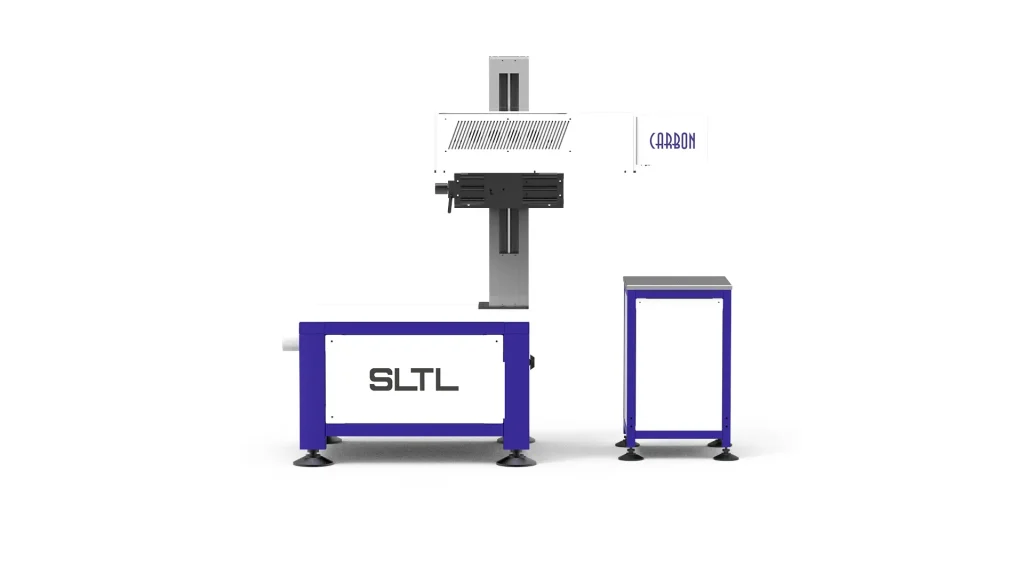
Carbon – CO2 Industrial Marking Machine The Carbon is designed for higher-volume industrial marking environments, including mass production of composite panels, plastic name plates, and polymer-encased electrical components.
Laser Cutting Machines
Traceability does not begin at the marking station — it begins when raw material is processed. SLTL’s laser cutting systems for aerospace maintain the dimensional accuracy that allows subsequent marking to be reliably positioned.
Future X — SLTL’s most advanced laser cutting system, equipped for aerospace-grade aluminium sheet cutting, sandwich aluminium sheet cutting, and composite cutting where tight tolerances and cut-edge quality are mandatory.
Infinity F1 — Heavy-duty, high-power laser cutting machine for thick aerospace structural material, including structural steel, titanium plate, and heavy aluminium sections.
IntegreX — An accessible, productivity-focused laser cutter suited to production environments processing standard aluminium sheet and lighter aerospace structural components.
X5 — SLTL’s 3D laser cutting machine, designed for complex three-dimensional aerospace geometries including hydroformed sections, deep-drawn pressings, and tubular aerospace structures requiring precise 3D cut profiles.
For manufacturers integrating marking into a broader laser processing workflow, the connection between cutting accuracy and marking quality is explored in detail in Why Aerospace Manufacturers Need High-Accuracy Laser Processing.
Future Trends in Aerospace Part Identification
The requirements placed on part marking systems are evolving alongside broader digitalisation trends in aerospace manufacturing.
Digital thread integration. Manufacturers are linking physical part marking — particularly Data Matrix codes — to digital product definitions stored in PLM systems. The code on the part becomes the key that retrieves the full manufacturing record, inspection data, and design history. Laser marking systems capable of receiving dynamic data strings from MES via Ethernet are already supporting this workflow.
Smaller marks, denser data. As miniaturisation continues in avionics and electronic assemblies, the marking areas available on components are shrinking. Fiber laser systems with high-resolution galvo scanning are pushing the limits of mark density, enabling full traceability data in symbol sizes below 3 × 3 mm.
Non-destructive marking verification. Post-marking verification using camera-based grading systems is becoming a standard step in aerospace marking workflows. Some manufacturers are integrating vision verification directly into the marking cell, generating a grade report for each part that is attached to its quality record.
Laser welding and marking integration. For manufacturers producing welded aerospace assemblies, the combination of laser welding for structural joining and laser marking for traceability within a single production cell reduces handling and cycle time while maintaining the thermal accuracy both processes demand.
SLTL: Your Aerospace Laser Marking Partner
SLTL has supported aerospace manufacturers across cutting, welding, and marking applications with systems designed to meet the demands of regulated, high-precision production environments. Whether you are establishing a new traceability programme, upgrading from conventional marking methods, or integrating marking into an automated assembly line, SLTL’s engineering team can configure the right system for your component range, throughput, and compliance requirements.
Contact SLTL to discuss your aerospace traceability needs, request a machine demonstration, or explore integrated laser cutting and marking solutions for your production line.
📩Frequently Asked Questions
Which laser marking machine is best for aerospace parts? For most metallic aerospace parts — aluminium alloys, titanium, and stainless steel a fiber laser marking machine such as the SLTL ELITE or NEO is the preferred choice. These systems deliver the beam quality needed for fine Data Matrix codes and serial engraving at mark grades that meet aerospace programme requirements. For composite and plastic aerospace components, the OptiFly or Carbon CO2 systems are more appropriate.
Can laser marking survive aerospace operating conditions? Yes. Laser marks particularly laser-engraved and annealed marks — are integral to the material surface and are not affected by aviation fuels, hydraulic fluids, deicing chemicals, or the thermal cycling experienced during aircraft operation. This is one of the primary reasons aerospace standards specify permanent marking methods rather than applied labels or ink.
Is laser marking compliant with aerospace traceability standards? Laser marking is explicitly recognised as a compliant permanent marking method under AS9100, MIL-STD-130, AMS 2816, and EASA Part 21 frameworks. The mark must meet legibility, durability, and, where applicable, Data Matrix verification grade requirements specified in the programme’s quality plan.
Which SLTL machine is best for Data Matrix marking on aerospace components? The SLTL ELITE and NEO fiber laser marking machines are the primary choices for Data Matrix marking. Both systems support vector-based Data Matrix generation at the controller level, with power and speed parameters optimised for mark grade compliance. The Flexy is recommended where large or immovable components must be marked in place.
Can laser marking be integrated with ERP and MES systems? Yes. SLTL laser marking machines support serial and Ethernet communication interfaces that allow production control systems to push dynamic data part numbers, serial numbers, date codes directly to the marking controller. This eliminates manual data entry, prevents transcription errors, and enables automatic lot tracking at the point of marking.
What is the difference between 2D and 3D laser marking in aerospace? 2D laser marking is performed on flat or near-flat surfaces using a standard galvo scan head. 3D laser marking uses dynamic focus control to maintain consistent mark quality across curved or compound-geometry surfaces essential for tubes, castings, forgings, and other non-planar aerospace components.
Is it possible to mark composite aerospace parts with a laser? Yes, with the correct laser source. CO2 laser systems (such as the SLTL OptiFly and Carbon) are suitable for surface marking on thermoset composites, CFRP panels, and engineering polymers. Fiber laser systems are not typically recommended for CFRP due to the risk of fibre ablation; CO2 wavelengths interact with the polymer matrix without damaging the reinforcing fibres when parameters are correctly set.