
The Problem with Cutting Composite Materials the Old Way
Aerospace composites are not like steel. They are not homogeneous. They are not forgiving. And they absolutely do not respond well to brute mechanical force.
Carbon fibre reinforced polymers (CFRP), glass fibre laminates, aramid-based structures, and sandwiched aluminium sheet assemblies are all engineered for one purpose: maximum strength at minimum weight. But that same anisotropic, layered architecture that makes composites so valuable in aircraft structures also makes them extraordinarily difficult to cut, trim, and finish using conventional methods.
The aerospace industry has been wrestling with this challenge for decades. And increasingly, laser cutting composite aerospace components is emerging not just as an alternative but as the only rational solution for manufacturers who care about edge quality, structural integrity, and production repeatability.
This blog explores why contactless laser processing is critical for modern aerospace composite manufacturing, what happens when you rely on mechanical cutting, and how the right laser technology transforms production outcomes. This article is part of a broader discussion on precision manufacturing — for a comprehensive view, refer to our blog: Why Aerospace Manufacturers Need High-Accuracy Laser Processing.
Challenges of Cutting Aerospace Composite Materials
Composite materials in aerospace are rarely a single substrate. A typical aerostructure panel might combine:
- Carbon fibre woven prepreg layers
- Honeycomb aluminium core
- Resin matrix binding multiple orientations of fibre
- Protective surface films or coatings
Each of these layers responds differently to heat, pressure, and vibration. When you cut through the stack with a rotating tool a drill, a router bit, a waterjet you are applying mechanical force across all these layers simultaneously. The result is predictable and consistently problematic.
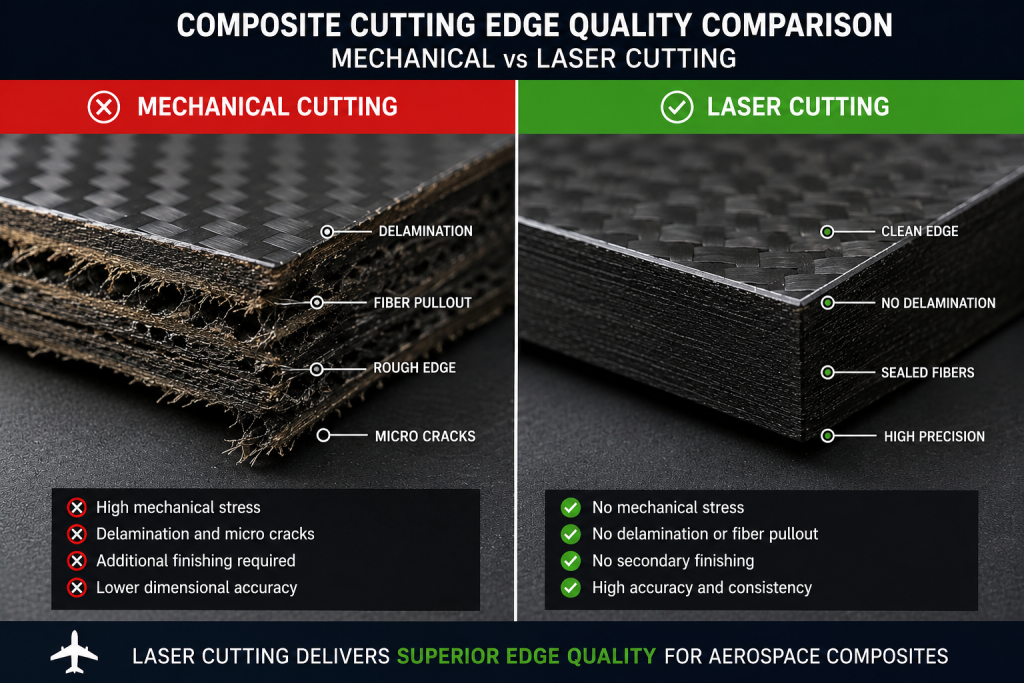
Delamination occurs when the bond between composite layers fails under the lateral stress of a cutting tool. Even a micro-delamination invisible to the naked eye can propagate into a structural failure under flight loads. This is not a cosmetic issue it is an airworthiness concern.
Fibre pullout happens when rotating tools snag individual fibres instead of cleanly severing them. The result is a ragged, weakened edge that requires secondary processing and still never quite matches the original material specification.
Burr formation particularly at the exit point of a drill or router creates stress concentrations that must be removed before assembly. In a high-volume production line, deburring is a time sink and a quality risk.
Tool wear is aggressive on composite-cutting tooling. The abrasive nature of carbon fibre destroys carbide tooling rapidly, which means both ongoing consumable cost and the risk of degraded cut quality as tools wear between changes.
None of these problems are solved by using better mechanical tooling. They are inherent to any process that involves contact between a cutting tool and a composite substrate.
Why Mechanical Cutting Creates Stress and Delamination
Understanding the physics makes the limitation clear.
Mechanical cutting works by applying a concentrated force shear, abrasion, or fracture to a material. In homogeneous metals, this works well because the material responds uniformly. In composites, the fibre and matrix phases have dramatically different mechanical properties. Fibres are stiff and brittle along their length. The matrix is relatively compliant. Interfaces between plies are the weakest link in the stack.
When a rotating router bit contacts a CFRP panel, it does not cleanly shear fibres. It bends them, compresses them, and then fractures them at some point along their length which may not be at the intended cut line. The tool also generates significant heat through friction, which can locally degrade the resin matrix and reduce interlaminar shear strength even if the cut itself looks acceptable.
Vibration transmitted through the tool during cutting induces cyclic stress at the ply interfaces exactly the mechanism that drives delamination initiation. High-speed machining reduces some of these effects but cannot eliminate them entirely.
The problem is compounded in sandwiched aluminium sheet structures. Here you have a metallic face sheet, a low-density core, and another face sheet. Mechanical cutting through this stack creates a transition point where the tool behaviour changes abruptly from cutting metal to cutting air to cutting metal again. The result is usually fretting, core crushing, or face sheet separation at the cut edge.
This is not a fixable problem. It is a fundamental constraint of contact-based cutting applied to multi-material layered systems.
Benefits of Contactless Laser Cutting for Composites
Laser cutting removes the contact problem entirely. A focused laser beam delivers energy directly to the material, vaporising or ablating it without any mechanical force transmission into the surrounding structure.
For aerospace composite processing, this changes the equation in several important ways.
No mechanical stress. Because the laser beam never touches the material beyond the focal point, there is no lateral force, no vibration transmission, and no tool deflection. The surrounding material remains in its original stressed state no induced residual stresses, no delamination initiation.
Sealed cut edges. As the laser ablates composite material, the matrix resin at the cut edge is locally melted and re-solidified, creating a sealed surface that encapsulates cut fibre ends. This prevents moisture ingress at the cut edge a significant concern in carbon fibre structures where exposed fibres can create galvanic corrosion pathways.
Elimination of delamination. Without the interlaminar shear stress that mechanical tools create, laser-cut composite panels consistently show zero delamination at cut edges when process parameters are correctly optimised. This is not achievable with mechanical methods.
Repeatability and programmability. Laser cutting is a numerically controlled process. Once a cutting programme is established and validated, every subsequent part is cut to the same parameters. There is no tool wear effect. There is no operator skill dependency. The 500th part is cut identically to the first.
Geometry freedom. Complex internal cutouts, curved trim lines, fine slots, and 3D contour cutting are all achievable without fixture redesign. This is particularly relevant for tube cutting applications in aerospace, where circular cross-sections and angled cuts must be made accurately on structural tubes and hydraulic lines.
Reduced secondary processing. A well-optimised laser-cut edge typically requires no deburring, no sanding, and minimal inspection before proceeding to assembly. This directly reduces cycle time and labour cost per part.
For manufacturers already familiar with the advantages of laser technology in metal processing, the transition logic for composites is the same but the quality benefits are even more pronounced because composite materials are so much more sensitive to the damage mechanisms that laser processing eliminates.
Applications in Aerospace Manufacturing
Laser cutting composite aerospace structures is not a single use case. It spans the full breadth of modern aerostructure production:
Structural panels and skins. Wing skins, fuselage panels, and control surfaces are routinely trimmed to net shape after layup and cure. Laser processing delivers the dimensional accuracy and edge quality that these structural applications demand.
Sandwiched aluminium sheet cutting. Laser systems handle the transition between face sheet and core cleanly, without the core crushing and edge separation that mechanical methods produce. The result is a geometrically accurate, structurally sound cut edge ready for bonding or fastening.
Composite tube cutting. Hydraulic lines, structural tubes, and ducting components require precise length cuts and angled end faces. 3D laser cutting systems manage the geometry of cylindrical workpieces with the same accuracy as flat panel cutting.
Interior components. Cabin panels, floor structures, and overhead bin assemblies are manufactured in high volumes from lightweight composite materials. Laser cutting enables the throughput and repeatability that interior production programmes require.
2D and 3D marking. Traceability is a regulatory requirement in aerospace. Every part must carry an identifier a serial number, a batch code, a specification reference. Laser marking achieves this without contact, without consumables, and with permanent mark quality that survives paint, anodising, and service life.
Nameplate marking. Identification plates on aerospace hardware are typically marked with part numbers, specifications, and certification data. Laser nameplate marking produces legible, permanent marks that comply with aerospace traceability standards.
Airbag composite material cutting. In automotive aerospace crossover applications particularly advanced safety systems and deployable structures laser cutting of airbag composite components is increasingly specified for its precision and repeatability.
If you are exploring how laser technology integrates into broader aerospace production workflows, our pillar article on why aerospace manufacturers need high-accuracy laser processing provides a comprehensive foundation for understanding the full scope of laser applications across the production chain.
Composite Material Types Used in Aerospace
Different composite architectures present different laser processing requirements. Understanding the material drives the process specification:
Carbon Fibre Reinforced Polymer (CFRP) is the workhorse of structural aerospace composites. It has high specific stiffness and strength, excellent fatigue resistance, and responds well to laser processing when parameters are tuned for the resin system in use. The primary challenge is heat management CFRP fibres conduct heat along their length, which can cause a heat-affected zone if energy density and feed rate are not correctly balanced.
Glass Fibre Reinforced Polymer (GFRP) is optically transparent at many laser wavelengths, which requires wavelength selection to match absorption characteristics. Fibre Bragg grating and CO2 laser systems are commonly used for GFRP processing.
Aramid composites (Kevlar-based structures) are used in impact-resistant applications. These materials are difficult to cut mechanically due to their toughness and fibre ductility they tend to deflect rather than sever. Laser ablation circumvents this entirely.
Thermoplastic composites (PEEK, PPS matrix systems) are increasingly used in aerospace for their weldability and recyclability. Laser cutting thermoplastic composites produces clean edges with no fibre pullout, and the matrix material re-solidifies cleanly at the cut line.
Hybrid and sandwiched structures combining metallic and polymer composite layers require laser systems capable of managing the different absorption characteristics of each layer through the cut depth.
How Laser Processing Improves Production Accuracy
For production engineers, accuracy is not just about the dimension on a drawing. It is about the consistency of that dimension across an entire production run across shifts, across operators, across machine states.
Laser cutting composite aerospace components delivers this consistency because the process is fundamentally different from mechanical cutting in its error sources.
Mechanical cutting accuracy degrades as tools wear. A fresh router bit produces a different cut profile than one at 60% of its service life. Monitoring and compensating for this requires sophisticated in-process measurement and tool management systems.
Laser cutting accuracy is governed by the beam delivery system, the motion platform, and the focus control all of which are monitored and maintained to tighter tolerances than any mechanical tooling system. There is no wear mechanism that progressively degrades the cut quality.
Repeatability across a production run of laser-cut composite parts is routinely achieved at tolerances of ±0.1mm or better for straight and curved trim cuts. For drilling and circular cutouts, positional and diameter tolerances of similar magnitude are achievable without secondary operations.
This level of consistency directly reduces the inspection and rework burden on the production line. When every part is cut identically, inspection sampling can be reduced and statistical process control applied with confidence.
For aerospace manufacturers managing complex part families across multiple production schedules, this consistency translates directly into lower cost per part and higher schedule confidence.
Why Manufacturers Are Switching to Laser Technology
The commercial case for switching to laser cutting composite aerospace is clear when the full cost picture is examined not just the capital equipment investment, but the total cost of ownership across the production programme.
Tooling cost elimination. A high-volume composite trim operation using router tooling may consume significant tooling budgets annually. Laser systems have no cutting tool consumables. The operating cost reduction over a programme lifetime can be substantial.
Reduced scrap and rework. Delamination and fibre pullout in mechanically cut parts are not always detectable immediately. When discovered at assembly, the scrap and rework cost is amplified by the downstream processing already completed on the part. Laser-cut parts with consistently sound edges dramatically reduce this late-stage scrap rate.
Labour reduction. Deburring, edge finishing, and inspection of mechanically cut composite parts is labour-intensive. Laser-cut parts require significantly less secondary labour, which at aerospace labour rates represents meaningful cost reduction.
Flexibility and reprogram ability. When a design change occurs as it inevitably does in aerospace development programmes a laser cutting programme is updated in software. Mechanical tooling may require new fixtures, new templates, or new tooling geometry, each with its own lead time and cost.
Quality assurance alignment. Aerospace quality systems require documented evidence that production processes are in control. Laser cutting systems log process parameters power, speed, focal position, assist gas pressure for every cut. This data is a natural fit for the process documentation requirements of AS9100 and similar quality frameworks.
For manufacturers already investigating the transition, our supporting article on laser processing accuracy for aerospace production examines the metrology and process control aspects in detail.
Recommended SLTL Machines for Aerospace Composite Processing
Selecting the right laser platform for composite processing depends on the production requirement part size, material thickness, geometry complexity, volume, and marking requirements. Below is an overview of how different SLTL systems address common aerospace composite processing scenarios.
Laser Cutting Machines
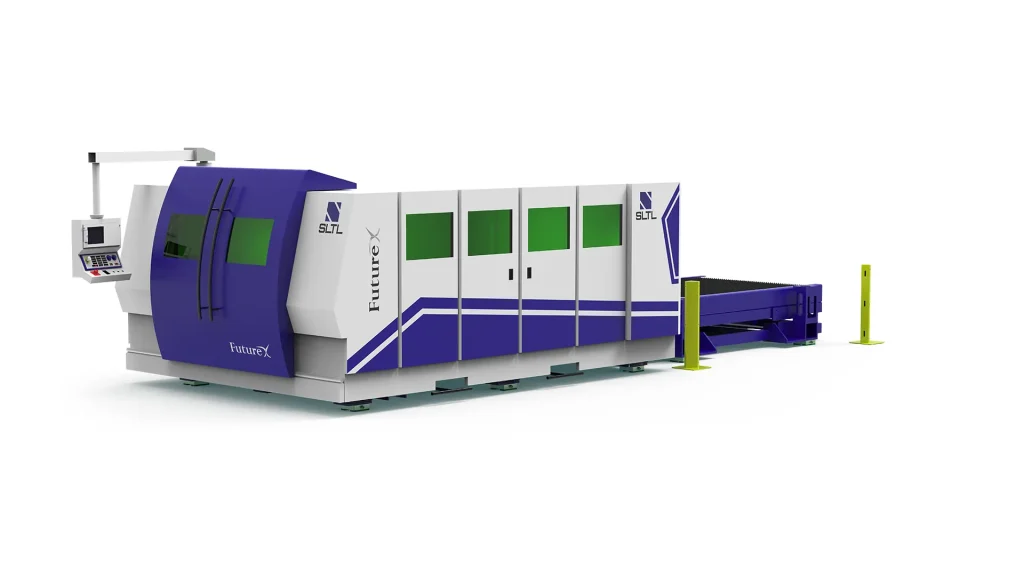
Future X is designed for advanced aerospace applications where cutting accuracy and material handling demands are highest. It handles complex geometry cutting on large-format composite panels with the beam quality and motion control precision that structural aerospace components require.
Infinity F1 addresses high-power, heavy-duty cutting requirements. Where production involves thick composite stacks or high-throughput panel cutting, the Infinity F1’s power capability ensures consistent edge quality without compromising cut speed.
IntegreX is positioned as a productive, accessible platform for manufacturers introducing laser composite cutting into their workflow. It delivers reliable performance on standard aerospace composite thicknesses without the complexity overhead of larger systems.
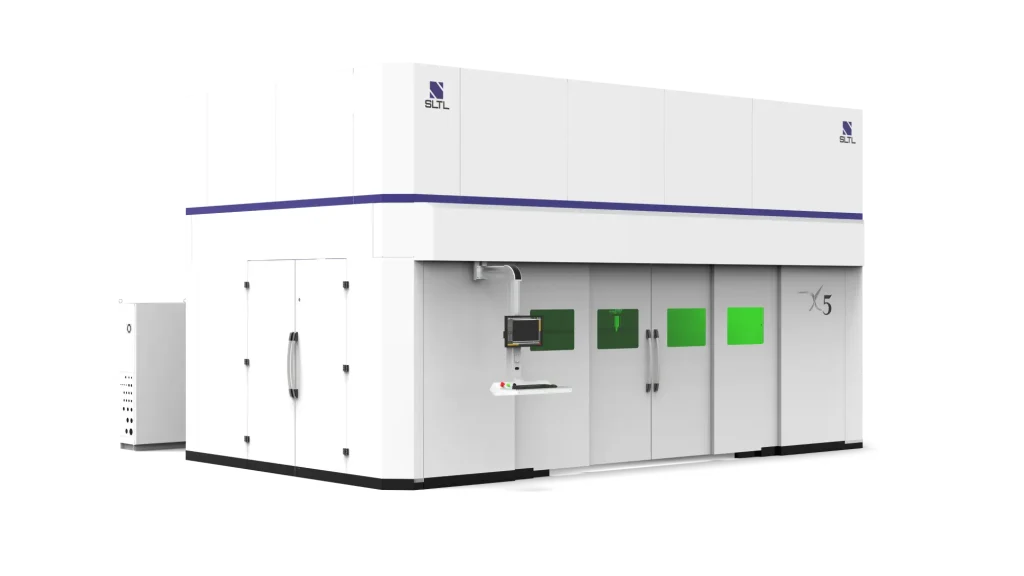
X5 is the platform of choice when 3D composite cutting is the requirement. Curved aerostructure components, tube cutting applications, and complex contour trim operations on formed composite parts are all natural X5 applications.
Laser Marking Machines
Traceability in aerospace is non-negotiable. Every part that leaves the production floor must be permanently identified. Laser marking delivers this without consumables and with mark quality that survives the full service life of the component.
Nova is a fibre laser marking system suited to component traceability marking serial numbers, batch codes, and specification references on structural parts and subassemblies.
REX uses diode laser technology for traceability marking where lower heat input is required, particularly on surface-sensitive composite components where the marking process must not affect the underlying substrate.
ELITE is designed for fibre hallmarking applications high-precision, high-contrast marks on metallic and composite components where mark legibility and permanence are critical.
Flexy addresses the practical challenge of marking parts that cannot easily be brought to a fixed marking station. As a movable marking system, it is well suited to large aerostructure components and in-situ marking of installed assemblies.
NEO offers high-power multipurpose fibre marking capability for applications requiring deep marking or high throughput across a range of aerospace component types.
Ultra provides low-power precision marking for applications where fine mark resolution and minimal heat-affected zone are the priority optical components, sensor housings, and other precision-sensitive aerospace parts.
OptiFly uses CO2 laser technology for marking on polymer and composite surface materials cabin interior panels, protective films, composite nameplates, and high-volume marking applications in aerospace interior production.
Carbon rounds out the CO2 marking range with capabilities suited to carbon-based material marking and general composite surface identification applications.
Explore our full range of laser cutting machines and laser marking machines to find the right configuration for your composite processing programme.
Take the Next Step in Composite Processing
Aerospace manufacturers who continue to rely on mechanical cutting for composite components are accepting a cost and quality penalty that compounds over every production cycle in tooling, in rework, in inspection, and in the downstream consequences of edge quality variability.
Laser cutting composite aerospace structures eliminates these penalties at the source. Contactless processing means no delamination risk, no burr formation, no tool wear degradation, and no secondary finishing for the vast majority of cut geometries. The result is a cleaner production process, a lower total cost per part, and a quality assurance story that aligns with the rigorous documentation requirements of aerospace production.
SLTL’s range of laser cutting, marking, and processing systems is designed specifically to meet the demands of aerospace composite manufacturing from structural panel cutting on the Future X platform to precision traceability marking on the Nova and REX systems.
Frequently Asked Questions
Q: Why is laser cutting better for composites than mechanical routing?
Mechanical routing applies contact force to the composite layup, generating vibration, heat from friction, and lateral stress at ply interfaces. This causes delamination, fibre pullout, and burr formation. Laser cutting applies energy without physical contact, vaporising material cleanly with no mechanical stress transmission — producing sealed, delamination-free edges that require no secondary finishing.
Q: Does laser cutting create a heat-affected zone in carbon fibre composites?
All thermal cutting processes create some level of heat-affected zone (HAZ). In laser processing of composites, HAZ size is controlled through process parameter selection pulse duration, energy density, feed rate, and assist gas flow. With correctly optimised parameters, the HAZ in laser-cut CFRP is typically confined to a narrow band that does not affect structural properties of the part.
Q: What composite materials can be laser cut in aerospace applications?
CFRP, GFRP, aramid composites (Kevlar-based), thermoplastic composites (PEEK, PPS), and hybrid sandwiched aluminium sheet structures are all processable with laser systems. The specific laser wavelength, power level, and process parameters are selected to match the material’s optical and thermal properties.
Q: How does laser marking support aerospace traceability requirements?
Aerospace regulatory frameworks require permanent, legible part identification throughout the service life of a component. Laser marking produces marks directly in the substrate material not applied coatings that can be removed with character sizes and contrast levels that meet aerospace marking standards. The process is also fully documentable, supporting AS9100 and other quality system requirements.
Q: Can laser systems handle 3D composite cutting for curved aerostructure components?
Yes. 5-axis laser cutting platforms such as the SLTL X5 process curved and contoured composite components with the same dimensional accuracy as flat panel cutting. The cutting head maintains correct focal distance and beam angle relative to the workpiece surface throughout the cut path, regardless of part geometry.
Q: What is the production efficiency improvement when switching from mechanical to laser composite cutting?
The efficiency gain varies by application, but manufacturers typically see reductions in cycle time from elimination of deburring and edge finishing, reductions in scrap from consistent edge quality, reductions in tooling cost from elimination of mechanical cutting consumables, and improvements in throughput from higher cutting speeds on thin to medium composite gauges. Total cost-per-part reductions of 20–40% are achievable in well-optimised laser composite cutting implementations.
Q: How do I select the right laser machine for my aerospace composite production line?
Machine selection depends on part size and geometry, composite material type and thickness, required cutting accuracy, production volume, and whether 2D or 3D cutting is required. SLTL application engineers assess these parameters and recommend the appropriate platform whether that is the Future X for high-complexity structural panel cutting, the X5 for 3D composite applications, or one of the marking systems for traceability requirements.