
When an aerospace manufacturer evaluates a new cutting process, the decision rarely comes down to a single factor. Edge quality, material compatibility, production throughput, tooling costs, and the ability to scale automation all weigh in simultaneously. In the ongoing debate of laser cutting vs CNC routing aerospace applications, both technologies have earned their place on the shop floor — but they serve different purposes, and confusing one for the other leads to avoidable rework, scrap, and cost overruns.
This blog breaks down the technical differences between laser cutting and CNC routing for aerospace sheet and composite parts, covering everything from kerf width and heat-affected zones to traceability marking and 3D contour cutting. If you are evaluating fabrication technologies for CFRP panels, honeycomb structures, aluminium brackets, or aircraft interior components, this comparison will help you make a more informed decision.
For a broader view of why precision processing matters across your entire production environment, refer to our resource: Why Aerospace Manufacturers Need High-Accuracy Laser Processing.
What Is CNC Routing in Aerospace Manufacturing?
CNC routing is a subtractive machining process where a rotating cutting tool — typically a carbide or diamond-tipped router bit is guided by a computer numerical control system to remove material along a programmed path. In aerospace manufacturing, CNC routers are commonly used to cut composite panels, honeycomb cores, and aluminium sheet stock, particularly for parts with larger feature geometries.
The technology has been a workhorse in aerospace fabrication for decades. It handles a wide variety of materials and does not require a laser-safe operating environment. However, CNC routing introduces a set of process limitations that matter increasingly as aerospace tolerances tighten and production schedules compress.
Key characteristics of CNC routing in aerospace:
- Material removal through mechanical contact, generating heat and tool wear progressively
- Kerf width determined by cutter diameter typically 3 mm to 10 mm limiting minimum feature size
- Tool pressure during cutting can cause delamination in CFRP and glass-fibre composites
- Router bits require regular replacement, particularly when cutting abrasive carbon fibre or reinforced composites
- Dust and particulate generation from composite cutting requires extraction systems and operator PPE
- Setup time includes tool changes, fixture clamping, and edge-dressing after machining
These constraints do not make CNC routing obsolete, but they do define where it should and should not be used.
What Is Laser Cutting for Aerospace Parts?
Laser cutting uses a focused, high-energy beam most commonly a fibre laser or CO₂ laser to melt, vaporise, or ablate material along a programmed path. In aerospace manufacturing, laser cutting machines are used for precision sheet cutting, composite trimming, bracket fabrication, tube profiling, and 3D contour cutting of formed parts.
Because the process is contactless, laser cutting eliminates tool wear, removes the risk of mechanical delamination in composites, and delivers a consistently narrow kerf with minimal material distortion when parameters are correctly set. Modern fibre laser cutting machines can achieve positional accuracy to ±0.05 mm and repeat cut-to-cut tolerances well within aerospace drawing requirements.
For composite-specific applications, explore our detailed resource on Composite Laser Cutting in Aerospace Manufacturing to understand parameter selection for CFRP, GFRP, and Kevlar laminates.
Key characteristics of laser cutting in aerospace:
- Non-contact process — no cutting forces, no mechanical stress on the workpiece
- Kerf width typically 0.1 mm to 0.5 mm, enabling high-density nesting and minimal material loss
- High repeatability from first part to ten-thousandth part with no tooling degradation
- Capable of cutting complex 2D profiles and 3D contoured aerospace parts without fixture changes
- Easily integrates with automated material handling, part marking, and quality inspection
- Laser marking capability on the same platform enables serial number engraving and traceability marking without secondary operations
Laser Cutting vs CNC Routing Aerospace: Key Differences
The following table presents a direct technical comparison across the criteria that matter most in aerospace production decision-making.
| Criterion | Laser Cutting | CNC Routing |
| Edge Finish | Smooth, sealed edges on composites and metals | Can leave fraying, burrs, or micro-delamination |
| Kerf Width | 0.1 – 0.5 mm | 3 – 10 mm |
| Heat-Affected Zone (HAZ) | Narrow and controllable with correct parameters | Mechanical heat from friction, harder to control |
| Tooling Wear | No tooling beam only | Progressive wear; frequent tool changes on abrasive composites |
| Repeatability | ±0.05 mm part to part | ±0.1 mm or greater depending on tool wear state |
| Maintenance | Periodic optics cleaning and gas system checks | Daily tool inspection and regular spindle servicing |
| Automation | High integrates with robotic loading, nesting, and marking | Moderate requires fixture changes and tool management |
| Composite Compatibility | Excellent for CFRP, GFRP, and hybrids with correct laser type | Risk of delamination and fibre pull-out |
| Speed | Very high for thin sheet and complex profiles | Moderate; constrained by feed rate and tool life |
| Precision | ±0.05 mm achievable | ±0.1 mm or lower as tool wears |
| Operating Cost | Lower long-term no consumable tooling | Higher due to router bit replacement |
| Scalability | Easily scaled with multi-head or robotic cell integration | Scaling requires additional machines and fixturing |
Edge Quality Comparison for Composite and Aluminium Parts
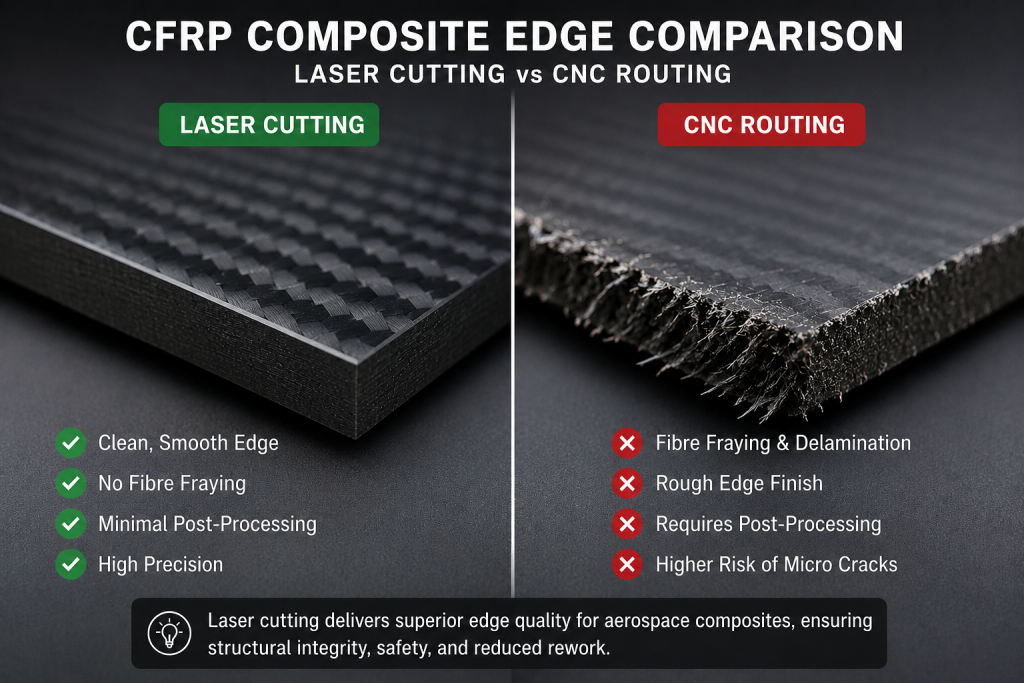
Edge quality is a non-negotiable parameter in aerospace fabrication. Poor edges whether from fraying in composites or burring in metal sheet introduce stress concentrations, complicate bonding operations, and often require secondary hand-finishing that adds labour cost and variability.
In CFRP and composite panels, CNC routing generates a mechanically fractured cut face. Even with sharp tooling, the process can pull individual fibres at the edge, creating micro-delamination zones that must be inspected and often repaired before bonding or painting. This is particularly problematic in sandwich panels with honeycomb cores, where router pressure can crush or separate the core material near the cut boundary.
Laser cutting, by contrast, severs fibres by vaporisation rather than fracture. When process parameters power, speed, assist gas composition, and focal position are correctly set for the specific laminate stack, the result is a clean, sealed edge with no fibre pullout and minimal charring. This is especially valuable when cutting aircraft interior panels or composite brackets destined for secondary bonding.
Repeatability and Precision in Aerospace Production
Aerospace drawing tolerances for sheet metal and composite components often sit between ±0.05 mm and ±0.25 mm, with some structural brackets and skin panels demanding the tighter end of that range. Maintaining those tolerances across a production batch of hundreds or thousands of parts is where the fundamental difference between laser and routing becomes commercially significant.
CNC router precision degrades with tool wear. A new carbide bit may hold ±0.1 mm reliably, but after several hours of cutting abrasive CFRP, dimensional drift is common without active tool-wear compensation or frequent bit changes. This introduces batch-to-batch variation that compounds quality inspection burden.
Fibre laser cutting maintains positional accuracy independently of any consumable wear state because there is no tool in contact with the material. A well-maintained laser cutting machine will cut the ten-thousandth part to the same tolerance as the first, provided the focus optics and gas delivery systems are serviced on schedule. For aerospace manufacturers running serialised production, this is a meaningful productivity and quality advantage.
Material Compatibility and Process Limitations
Neither laser cutting nor CNC routing is universally applicable to every aerospace material. Understanding the boundary conditions for each process avoids costly mis-application.
Where laser cutting performs well:
- Aluminium alloys (1xxx, 2xxx, 6xxx series) in sheet form up to 25 mm with high-power fibre laser
- CFRP and GFRP composites with correctly tuned pulse or CW parameters
- Titanium sheet and thin-gauge titanium structures
- Stainless steel aerospace components and fairings
- Honeycomb panel trimming and profiling
- Aerospace tubes and extrusions using 3D laser cutting capability
Where CNC routing may still be preferred:
- Very thick composite lay-ups (>20 mm) where laser penetration and HAZ become challenging to manage
- Foam core sandwich panels where laser energy is absorbed unevenly
- Parts requiring complex undercuts or pockets that cannot be addressed from a single direction without a 5-axis laser head
- Production environments where laser-safe enclosures and gas infrastructure cannot be justified for small batch volumes
Laser cutting process limitation to manage: Highly reflective materials such as copper and brass require specific laser source selection. Certain thermoplastic composites can generate toxic fume during laser processing, requiring dedicated fume extraction.
Productivity and Automation Comparison
In a modern aerospace manufacturing environment, the question is rarely just “which process gives better cut quality” it is “which process integrates into our production flow with the lowest total labour and overhead per part.”
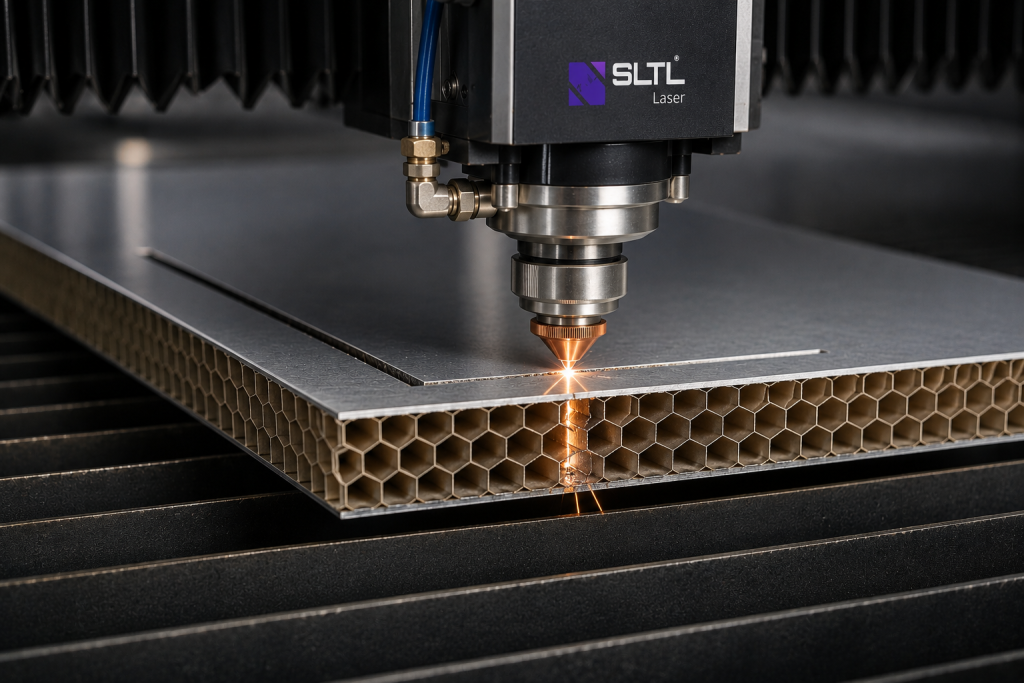
Laser cutting machines offer a more natural path to automation. A fibre laser cutting machine can integrate with automated sheet loading and unloading, CNC nesting software that minimises material scrap, vision-guided part positioning, and inline laser marking for traceability all within a single cell. This means an operator can run multiple machines simultaneously, reducing direct labour per part significantly.
CNC routing requires more hands-on intervention: tool changes, workholding setup, chip and dust extraction management, and edge-finishing after cutting. The physical nature of the process makes full automation harder and more expensive to implement.
For large aerospace programmes producing repeated part numbers across long production runs, laser cutting’s automation compatibility translates directly into lower per-part cost and more consistent schedule adherence.
Why Aerospace Manufacturers Are Moving Toward Laser Processing
The shift is not driven by a single advantage. It reflects a convergence of factors: tightening tolerances in next-generation aircraft structures, the growing use of lightweight composites in place of aluminium, increasing demand for part-level traceability, and the commercial pressure to reduce total cost per unit.
High-power fibre laser cutting machines now routinely cut 8 mm aluminium aerospace sheet at feed rates that exceed what CNC routers can achieve with comparable edge quality. 3D laser cutting systems eliminate the need for secondary trimming operations on formed sheet metal aerospace brackets by cutting the net profile directly on the formed part. Laser marking machines on the production line replace offline nameplate affixing with direct-to-part serial marking that meets AS9100 and NADCAP traceability requirements.
For aerospace manufacturers evaluating traceability compliance specifically, our resource on Laser Marking for Aerospace Traceability covers data matrix codes, serial marking formats, and regulatory requirements in detail.
Recommended SLTL Machines for Aerospace Manufacturing
SLTL Group offers a portfolio of laser cutting and laser marking machines configured specifically for the demands of aerospace sheet and composite fabrication.
Laser Cutting Machines
Future X is SLTL’s advanced aerospace laser cutting solution, designed for manufacturers who need the highest levels of dynamic accuracy and cutting speed on aerospace-grade aluminium, titanium, and stainless sheet. Its precision motion system and intelligent focus control make it well suited for complex aerospace bracket profiles and skin panel cutting where edge quality directly affects downstream bonding and paint adhesion.
Infinity F1 is a heavy-duty high-power cutting machine built for aerospace manufacturers processing thick aluminium plate, structural aerospace sheet, and large-format panels. Where production volumes are high and material thicknesses vary across a programme, Infinity F1’s power headroom and robust construction reduce cycle times while maintaining tight tolerances.
IntegreX is an affordable, productivity-focused laser cutting machine for aerospace manufacturers who need reliable 2D sheet cutting capability without the capital expenditure of a flagship system. It is well suited for smaller aerospace fabricators cutting aluminium brackets, interior panel components, and sub-assemblies in medium batch volumes.
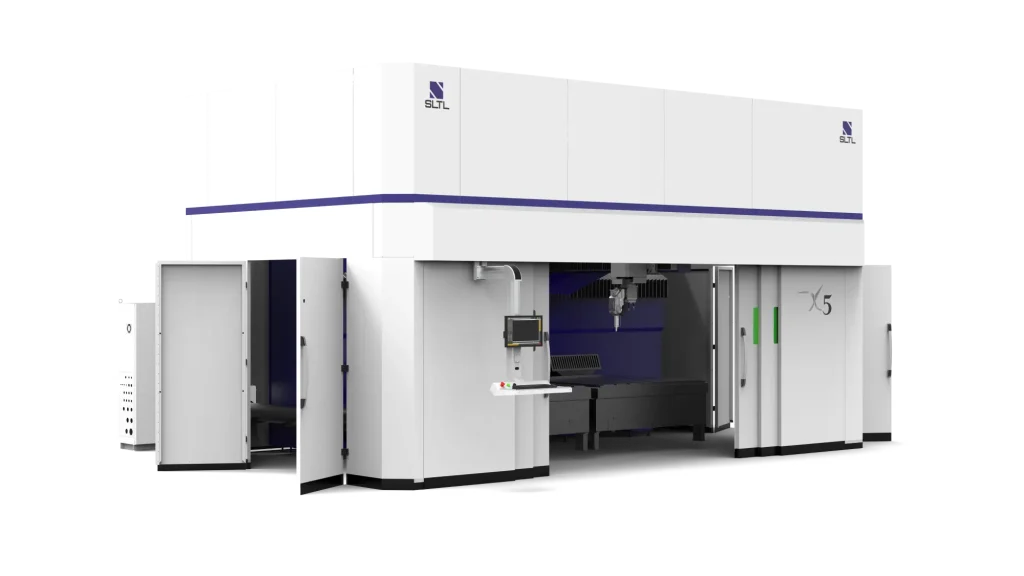
X5 is SLTL’s specialised 3D laser cutting machine, designed for cutting formed and hydroformed aerospace parts. When sheet metal brackets, structural clips, and tube sections require net-edge trimming after forming, the X5’s 5-axis cutting head follows the part contour precisely, eliminating the fixture-intensive secondary routing operations that are common in traditional aerospace sheet fabrication workflows.
Laser Marking Machines for Aerospace Traceability
Aerospace part traceability requirements under AS9100, NADCAP, and customer-specific quality plans demand permanent, machine-readable marking on every serialised component. SLTL’s laser marking machine portfolio covers the full range of aerospace marking applications.
Nova is purpose-built for traceability marking of aerospace components data matrix codes, serial numbers, part numbers, and revision identifiers on aluminium, stainless steel, and titanium parts at production line speed.
REX is a diode laser marking machine suited for aerospace traceability applications where compact footprint and integration into an existing production line are priorities.
ELITE is a fibre laser marking machine delivering high-contrast, permanent marks on aerospace metal parts, including batch serialisation and hallmarking applications where mark permanence under anodising or painting must be validated.
Flexy is a portable laser marking machine designed for large or fixed aerospace structures where bringing the part to the marker is not practical. Landing gear assemblies, large spar sections, and fuselage frames can be marked in-situ with the Flexy system.
NEO is a high-power multipurpose fibre laser marking machine handling a wide range of aerospace marking applications including deep engraving on hardened aerospace brackets and anodise-resistant marking on 7xxx series aluminium alloys.
Ultra is a low-power precision laser marking machine for fine-detail applications small aerospace nameplates, instrument panel labels, and high-resolution data matrix codes on compact components where mark area is constrained.
OptiFly is a CO₂ laser marking machine for plastic aerospace interior components passenger cabin trim panels, seat frame covers, and overhead bin components where fibre laser wavelengths are less effective on polymer substrates.
Carbon is a CO₂ marking system suited for broader aerospace marking applications on non-metallic materials, including composite surface marking and cable harness identification.
.
Final Comparison Summary
| Decision Factor | Choose Laser Cutting | Consider CNC Routing |
| Composite CFRP / GFRP cutting | ✅ Preferred | ⚠️ Delamination risk |
| Aluminium sheet aerospace parts | ✅ Preferred for thin to medium gauge | ✅ Viable for heavy gauge |
| Very thick composite (>20 mm) | ⚠️ Evaluate case by case | ✅ May be preferred |
| 3D formed part trimming | ✅ X5 5-axis laser | ❌ Complex fixturing required |
| Honeycomb panel cutting | ✅ Preferred | ⚠️ Core crush risk |
| Traceability marking integration | ✅ Same platform | ❌ Requires secondary operation |
| Automation compatibility | ✅ High | ⚠️ Moderate |
| Repeatability across long runs | ✅ No tool wear degradation | ⚠️ Degrades with tool wear |
| Operating cost long-term | ✅ Lower | ⚠️ Higher due to consumables |
Frequently Asked Questions
Q1: Is laser cutting more cost-effective than CNC routing for aerospace composites? In most production scenarios involving CFRP, GFRP, or hybrid composites, laser cutting delivers a lower total cost per part over a production programme. The elimination of tooling consumables, reduced secondary finishing, and automation compatibility offset the higher initial capital cost of a laser system, typically within 12–24 months of production volume. CNC routing has lower upfront machine cost, but ongoing router bit replacement on abrasive composites adds significantly to operating expense.
Q2: What edge quality can laser cutting achieve on CFRP aerospace panels? With correctly set fibre or ultrashort-pulse laser parameters, laser cutting of CFRP can deliver edges with no fibre pullout, no delamination, and a heat-affected zone below 0.3 mm in typical aerospace laminate thicknesses. The result typically passes visual and NDT inspection without secondary edge treatment. CNC routing of CFRP almost always requires post-cut edge inspection and often manual dressing.
Q3: Can laser cutting hold the tolerances required in aerospace manufacturing? Yes. Modern fibre laser cutting machines achieve positional accuracy of ±0.05 mm and maintain that tolerance across long production runs because there is no tooling wear to introduce dimensional drift. This is within the requirement range of most aerospace sheet and composite component drawings.
Q4: How does maintenance differ between laser cutting machines and CNC routers in an aerospace facility? A laser cutting machine requires periodic inspection and cleaning of focus optics, nozzle condition checks, and gas delivery system maintenance — typically scheduled as planned preventive maintenance events. CNC routers require daily tool condition monitoring, frequent router bit changes when cutting abrasive materials, and regular spindle bearing inspection. In high-volume composite cutting, the consumable and labour burden of router maintenance is substantially higher.
Q5: Can laser cutting be integrated into an automated aerospace production line? Yes. Laser cutting machines integrate readily with automated sheet loading and unloading systems, CNC nesting software, vision-guided positioning, and downstream robotic handling. SLTL’s laser cutting systems can be configured for lights-out or attended automation depending on part mix and batch size.
Q6: What is the advantage of 3D laser cutting for aerospace parts? A 3D laser cutting machine such as the SLTL X5 allows net-profile trimming of formed, hydroformed, and stretch-formed aerospace components without secondary fixturing. This eliminates the trim-and-inspect cycle that adds lead time in traditional CNC routing of formed brackets, clips, and structural details and delivers the cut accuracy needed for assembly fit-up without hand fitting.
Q7: How does laser marking support aerospace part traceability requirements? Laser marking machines engrave permanent, machine-readable marks data matrix codes, serial numbers, part numbers directly onto aerospace metal and composite parts. Laser marks survive anodising, painting, and the operational environment of an aircraft without degradation. This satisfies AS9100, NADCAP, and OEM-specific traceability requirements without adhesive labels or ink-based marking that can degrade in service. See our resource on Laser Marking for Aerospace Traceability for full regulatory context.
Q8: Is CNC routing still relevant for any aerospace applications? Yes, CNC routing remains appropriate for certain aerospace applications: very thick composite structures where laser penetration is a challenge, foam core sandwich panels, and complex pocket machining that requires multiple tool geometries in a single setup. The most effective aerospace fabrication facilities use both technologies where each delivers the best process result, rather than treating it as an either/or decision.