
Component suppliers face mounting pressure to prove that every weld they produce meets the structural, dimensional, and traceability requirements their customers demand. Laser welding quality aerospace standards are not optional considerations. These are fundamental requirements that determine whether a supplier qualifies for production contracts, passes certification audits, and delivers parts that perform safely across the full operational life of the aircraft.
This guide covers the quality checks aerospace buyers and suppliers must evaluate before investing in laser welding systems or selecting a welding vendor. It addresses weld consistency, inspection standards, traceability integration, and machine capability in practical, production-focused terms.
Related Reading: Why Aerospace Manufacturers Need High-Accuracy Laser Processing
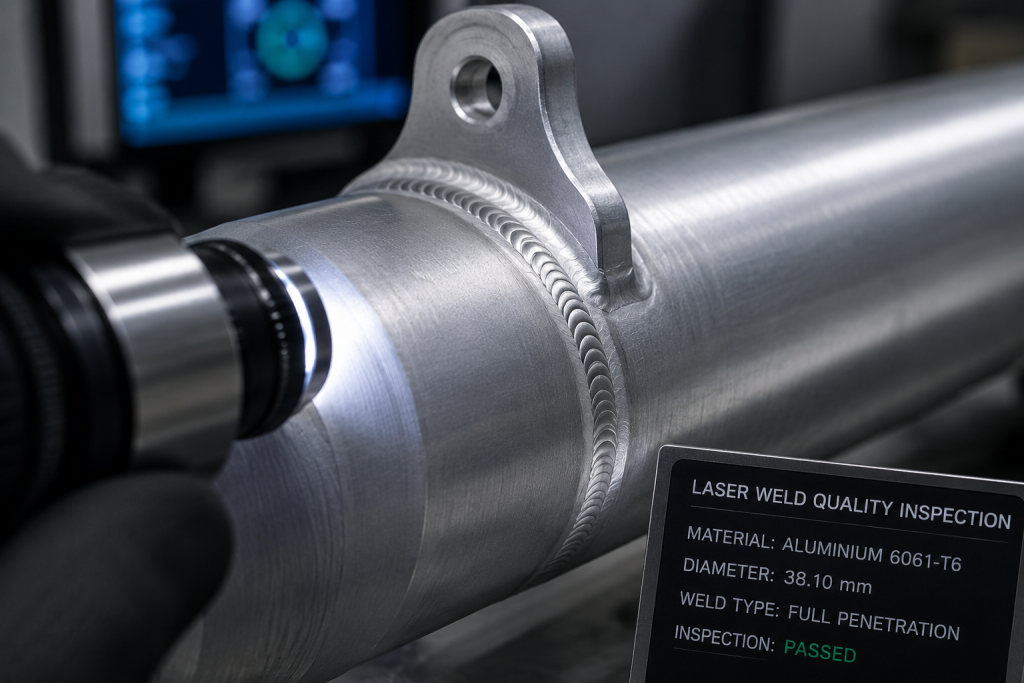
Why Weld Quality Matters in Aerospace Manufacturing
Structural Integrity Starts at the Weld
Every weld in an aerospace structure carries a share of the total load path. A weld that lacks full penetration, contains porosity, or introduces excessive residual stress becomes a potential failure point under fatigue loading. In aerospace manufacturing, fatigue loading occurs on every flight cycle. The cumulative effect of thousands of cycles tests every joint in the structure repeatedly throughout its service life.
Laser welding addresses this challenge more effectively than conventional arc or TIG welding methods. It delivers a narrow, deep weld bead with a small heat-affected zone. As a result, the surrounding base material retains its mechanical properties close to the joint. This characteristic is especially critical for titanium alloys, high-strength aluminium, and thin-wall stainless steel components that are sensitive to heat input.
Thermal Distortion and Tolerance Requirements
Aerospace assemblies work to tight dimensional tolerances. Excessive heat input during welding causes distortion, which pulls parts out of their designed geometry. In tube structures, frame members, and lightweight panels, distortion compounds across multiple joints and creates alignment problems at the assembly stage.
Laser welding uses a focused, high-intensity energy source with low total heat input. Consequently, thermal distortion is minimal compared to conventional welding processes. This allows aerospace manufacturers to hold dimensional tolerances through the welding stage and reduce or eliminate post-weld straightening and machining.
Lightweight Structures and Material Challenges
Modern aerospace assemblies increasingly use aluminium alloys, titanium alloys, and composite-supported structures to reduce weight. Each of these materials presents specific welding challenges. Aluminium requires careful control of heat input and shielding gas to prevent porosity and oxide inclusion. Titanium demands an inert atmosphere to avoid contamination and embrittlement. Thin-wall components across all materials need precise power modulation to achieve full penetration without burn-through.
Laser welding systems address all of these requirements through CNC process control, programmable power modulation, and closed-loop monitoring. Additionally, they support the welding of dissimilar material combinations that conventional processes cannot reliably join.
Key Quality Checks Buyers Should Evaluate Before Investment
Weld Penetration Consistency
Full and consistent weld penetration is the primary quality requirement for structural aerospace welds. Incomplete penetration leaves unfused base material at the root of the joint, which creates a crack initiation site under load. Buyers must verify that the laser welding machine can maintain consistent penetration depth across the full length of every weld, including on complex joint geometries and varying material thicknesses.
In practice, this means requesting weld cross-section samples and metallographic reports that demonstrate penetration consistency across multiple test welds. A supplier or machine vendor who cannot provide this data has not validated their process for aerospace applications.
Heat-Affected Zone Control
The heat-affected zone is the area of base material adjacent to the weld that experiences thermal changes during welding. In aerospace alloys, an excessively wide heat-affected zone reduces fatigue strength, alters microstructure, and can cause sensitization in stainless steel grades. For this reason, buyers must specify and verify heat-affected zone width as a measurable quality parameter.
Laser welding produces narrower heat-affected zones than any conventional arc welding process. However, achieving this consistently requires proper machine calibration, correct focal positioning, and accurate power and speed settings for each material and joint configuration.
Porosity and Microcrack Inspection
Porosity and microcracks are the most common internal defects in aerospace welds. Porosity forms when gas becomes trapped in the weld pool during solidification. Microcracks form due to thermal stress, improper shielding, or metallurgical incompatibility at the joint. Both defects are invisible to visual inspection, which means non-destructive testing is mandatory for aerospace weld quality assurance.
Buyers must confirm that the welding process and quality system include radiographic testing, ultrasonic testing, or both, depending on the joint type and applicable standard. Process validation records showing defect rates across production runs are essential for supplier qualification.
Dimensional Stability and Repeatability
Aerospace production runs require every welded assembly to meet the same dimensional specification. Dimensional variation between parts creates fit-up problems at higher assembly levels and can affect load distribution in the final structure. For this reason, buyers must evaluate the repeatability of the laser welding process, not just the quality of a single sample weld.
Repeatability evaluation requires reviewing dimensional inspection data from a statistically meaningful number of production parts, not just first-article samples. A capable process holds dimensional tolerances consistently across hundreds or thousands of parts.
Inspection and Traceability Standards in Aerospace Welding
Visual and Dimensional Inspection
Visual inspection of weld seam appearance is the first and most accessible quality check. A good-quality laser weld presents a consistent, uniform bead with no spatter, no undercut, and no surface porosity. The weld crown height and width must also stay within the tolerances specified for the joint design.
Dimensional inspection using coordinate measuring machines or optical measurement systems verifies that the welded assembly meets its geometric specification. Buyers must confirm that the supplier performs these checks on every part or at a defined sampling frequency, and that records are retained as quality documentation.
Non-Destructive Testing
Non-destructive testing methods evaluate internal weld quality without destroying the part. In aerospace welding, the most commonly applied methods include radiographic testing using X-ray or gamma sources, ultrasonic testing, and dye penetrant inspection for surface-breaking defects.
Each method suits different joint types and defect categories. Buyers must specify which non-destructive testing methods apply to their particular components and confirm that the supplier holds the relevant personnel certifications and equipment calibrations. Test records must also link to specific parts and production batches to support full traceability.
Batch Traceability and Certification Documentation
Aerospace quality management under AS9100 requires that every welded component carries traceable documentation linking it to its material certification, welder or process qualification, inspection records, and production batch. This traceability chain must survive the full life of the aircraft and support any future investigation, modification, or maintenance action.
Laser marking systems provide the most reliable method for applying permanent, machine-readable traceability codes to aerospace welded components. Data matrix codes marked in black using fiber laser annealing on titanium, stainless steel, or aluminium surfaces provide Grade A readability under AS9100 and MIL-STD-130 requirements. Name plate marking, serial coding, and component identification all integrate into the same laser marking workflow.
Integrating Laser Marking with Welding Workflows
SLTL’s laser marking systems integrate directly into aerospace welding production lines. The Nova (200 to 500W fiber) handles high-volume traceability marking on tough alloys including titanium and Inconel. The NEO (20 to 60W fiber) delivers precision data matrix marking on standard aerospace metal components. For large or complex welded assemblies that cannot move to a fixed marking station, the Flexy portable diode marker provides a practical solution.
For anodized aluminium and painted structural components, the REX diode laser provides reliable, cost-effective traceability marking. The ELITE fiber laser handles high-precision identification marking on small serialized aerospace parts. For composite and non-metallic components, the OptiFly CO2 system and Carbon CO2 machine deliver consistent marking on polymer and composite substrates. The Ultra (20 to 120W fiber) rounds out the range for lower-power multipurpose marking on varied aerospace metal specifications.
How Advanced Laser Cutting Machines Improve Aerospace Weld Quality
Why Upstream Cutting Accuracy Determines Weld Outcome
Weld quality does not start at the welding machine. It starts at the cutting stage. A laser-cut joint preparation with accurate edge geometry, consistent square edges, and minimal heat-affected zones sets up the welding process for success. By contrast, parts with rough cut edges, excessive burrs, or inconsistent edge geometry create variable weld gaps, uneven heat distribution, and inconsistent penetration from joint to joint.
The quality of the laser cutting system upstream directly determines how consistently the welding system downstream can perform.
SLTL Laser Cutting Systems for Aerospace Weld Preparation
Future X: The Future X is SLTL’s advanced laser cutting solution for aerospace sheet metal and structural profiles. It delivers precise edge quality on titanium, aluminium, and steel alloys, producing cut parts that move directly to welding without secondary edge preparation in most applications.
Infinity F1: The Infinity F1 is a heavy-duty, high-power laser cutting system for thick-section aerospace materials. It handles thick-wall structural components, sandwiched aluminium sheet cutting, and titanium plate cutting at production speed. The Infinity F1 provides the edge quality and dimensional accuracy that primary aerospace structure welding requires.
IntegreX: The IntegreX is an affordable, productivity-focused laser cutting machine suited to Tier 2 and Tier 3 aerospace suppliers. It handles medium-complexity tube and sheet profiles at high volume, providing consistent cut quality for downstream welding operations without the capital cost of a premium heavy-duty system.
X5 (3D Laser Cutting): The X5 is a specialized 3D laser cutting system for complex three-dimensional aerospace components. It handles compound-curved profiles, tube cutting on formed sections, and complex-geometry structural elements. For manufacturers welding complex aerospace frame nodes or hydroformed sections, the X5 provides joint preparation accuracy that conventional cutting systems cannot achieve on three-dimensional geometries.
Combining Cutting, Welding, and Marking in One Workflow
The greatest production efficiency gain in aerospace manufacturing comes from integrating laser cutting, laser welding, and laser marking in a single, connected workflow. Parts move from precise laser cutting directly to welding with no secondary edge preparation. After welding, laser marking applies permanent traceability codes before parts move to inspection and delivery. This integrated approach eliminates manual handling steps between processes, reduces cycle times, and maintains an unbroken traceability chain from raw material to finished component.
Questions Aerospace Buyers Should Ask Before Choosing a Laser Welding Supplier
Process Qualification and Standards Compliance
Before engaging a laser welding supplier, buyers need clear answers to specific process and compliance questions. The following questions form a practical qualification checklist.
What welding standards does the supplier follow? Suppliers must reference applicable standards such as AWS D17.1 for aerospace fusion welding, EN ISO 15614 for weld procedure qualification, and AS9100 for the quality management system. They must also provide documented weld procedure specifications and procedure qualification records.
Can the supplier provide weld samples on your material? Any credible laser welding supplier accepts material samples and provides test welds with dimensional reports, cross-section metallographs, and non-destructive testing results before production qualification begins.
Is traceability integrated into production? Traceability must cover the complete production chain from raw material certification through to finished component marking and delivery documentation. Suppliers who cannot demonstrate an integrated traceability system are not qualified for aerospace production contracts.
Machine and Production Capability
What laser welding machine technology does the supplier use? The laser source type, power range, beam delivery system, and CNC control capability all determine what materials and joint configurations the system can weld reliably. Buyers must evaluate machine specifications against their specific material and joint requirements.
Can the process maintain repeatability at production scale? Single-sample weld quality does not confirm production capability. Buyers must review statistical process data showing dimensional and defect rate performance across representative production quantities.
What materials does the system support? Confirm compatibility with all relevant aerospace alloys including titanium grades, aluminium series, Inconel, and stainless steel. Shielding gas arrangements for reactive materials such as titanium must also be confirmed.
Is automation available? High-volume aerospace production requires automated part handling, fixturing, and in-process monitoring. Suppliers who rely entirely on manual operation cannot offer the repeatability and throughput that aerospace volume production demands.
What aerospace customers or programmes does the supplier currently support? Reference customers and programme history provide the most direct evidence of real aerospace production capability.
Why Integrated Laser Processing Improves Aerospace Production Efficiency
The Cost of Disconnected Processes
Many aerospace manufacturers still run cutting, welding, and marking as separate, disconnected operations. Parts move between departments or suppliers at each stage. Each transfer adds handling risk, time, and potential for dimensional damage or traceability gaps. Moreover, each process handoff creates an opportunity for a non-conforming part to move forward before detection.
The Integrated Laser Processing Advantage
Integrating laser cutting, laser welding, laser marking, and traceability systems within a single production flow eliminates these risks. Parts move through each stage in sequence without manual repositioning or re-fixturing. The dimensional accuracy from laser cutting directly supports weld joint quality. Traceability marking after welding links back to the cutting and material records established at the start of the flow.
Production Examples Across Aerospace Applications
This integrated approach applies across a wide range of aerospace manufacturing scenarios:
- Sandwiched aluminium sheet cutting for fuselage interior panels, followed by laser welding of edge members and laser marking of identification codes
- Tube cutting for hydraulic system tube assemblies, followed by laser welding of fittings and data matrix traceability marking on each assembly
- Composite cutting for structural panel components, followed by non-metallic laser marking of part identification on CO2 systems
- Aerospace part marking for nameplate and serial number identification on finished welded assemblies
- 3D component processing on complex frame nodes using the X5 3D cutting system, integrated with welding and traceability marking in a single cell
For each of these applications, the combination of SLTL cutting, welding, and marking systems provides a complete, validated production capability from a single supplier.
Frequently Asked Questions
Q1: What weld quality standards apply to aerospace laser welding?
The primary standards for aerospace laser welding quality include AWS D17.1 for aerospace fusion welding processes, EN ISO 15614-11 for laser beam weld procedure qualification, and AS9100 for the overall quality management system. Specific programmes may also reference additional customer or OEM standards. Suppliers must hold documented weld procedure specifications and qualification records for all production weld configurations.
Q2: How does laser welding compare to TIG welding for aerospace applications?
Laser welding produces narrower weld beads, smaller heat-affected zones, and lower thermal distortion than TIG welding in most aerospace material and joint configurations. It also supports higher automation levels, faster cycle times, and better process repeatability across large production batches. TIG welding remains appropriate for certain joint access situations and specific material combinations. For high-volume, tight-tolerance aerospace structural welding, however, laser welding delivers superior process control and production efficiency.
Q3: What materials can aerospace laser welding systems process?
Laser welding systems process the full range of common aerospace structural materials. These include titanium alloys such as Ti-6Al-4V, aluminium alloys across the 2000, 6000, and 7000 series, stainless steel grades including 316L and 321, Inconel alloys for high-temperature applications, and some dissimilar material combinations. Each material requires specific laser parameters and shielding gas arrangements. SLTL applications engineers advise on process qualification for each material and joint configuration.
Q4: How do I verify that a laser welding supplier meets aerospace quality requirements?
Request the following before engaging a supplier: weld procedure specifications and qualification records, non-destructive testing reports on representative sample welds, AS9100 certification documentation, dimensional inspection reports from production batches, and traceability documentation demonstrating the complete chain from raw material to finished component. Weld cross-section metallographs and radiographic or ultrasonic test reports showing internal defect rates are also essential.
Q5: What role does laser marking play in aerospace weld quality compliance?
Laser marking applies permanent, machine-readable traceability codes to welded aerospace components. These codes link each component to its material certification, weld procedure, inspection records, and production batch. This traceability chain is mandatory under AS9100 and MIL-STD-130 requirements. Data matrix codes marked using fiber laser annealing on titanium and steel provide Grade A readability across the full service life of the component. SLTL laser marking systems integrate directly into welding production workflows.
Q6: Can SLTL laser welding systems integrate with automated production lines?
Yes. SLTL laser processing systems support automation integration through Ethernet, digital I/O, and robotic cell interfaces. This enables automated part loading, in-process monitoring, post-weld laser marking, and vision-based quality verification in a single automated production cell. As a result, manufacturers achieve consistent weld quality and throughput at aerospace production volumes without manual intervention between process stages.
Q7: What maintenance does an aerospace laser welding system require?
Fiber laser sources in aerospace welding systems are solid-state with no consumable gas or optical components requiring frequent replacement. Routine maintenance covers beam delivery optic cleaning, focal system calibration, shielding gas nozzle inspection, and CNC calibration checks. Periodic power output measurement also verifies that the laser source maintains the calibrated parameters across its service life. SLTL provides application support for process requalification after maintenance.