
The aerospace industry operates under some of the tightest engineering tolerances in the world. Every gram matters, every joint must endure extreme thermal and mechanical stress, and every component must meet stringent regulatory standards. It is in this demanding environment that laser welding aerospace components has emerged as a transformative manufacturing process one that is replacing conventional arc and TIG welding across aircraft frames, engine assemblies, satellite housings, and UAV structures.
Unlike traditional welding methods that apply broad, diffused heat to a joint, laser welding delivers a highly concentrated energy beam in a precisely controlled path. The result is a narrow, deep weld with a minimal heat-affected zone (HAZ), low structural distortion, and exceptional repeatability qualities that are non-negotiable in aerospace manufacturing.
This blog explores how laser welding supports lightweight aerospace manufacturing, the challenges it addresses, the machines that power it, and why it has become a cornerstone of the modern aerospace production workflow. This article is part of a broader discussion on precision manufacturing for a comprehensive view, refer to our blog: Why Aerospace Manufacturers Need High-Accuracy Laser Processing .
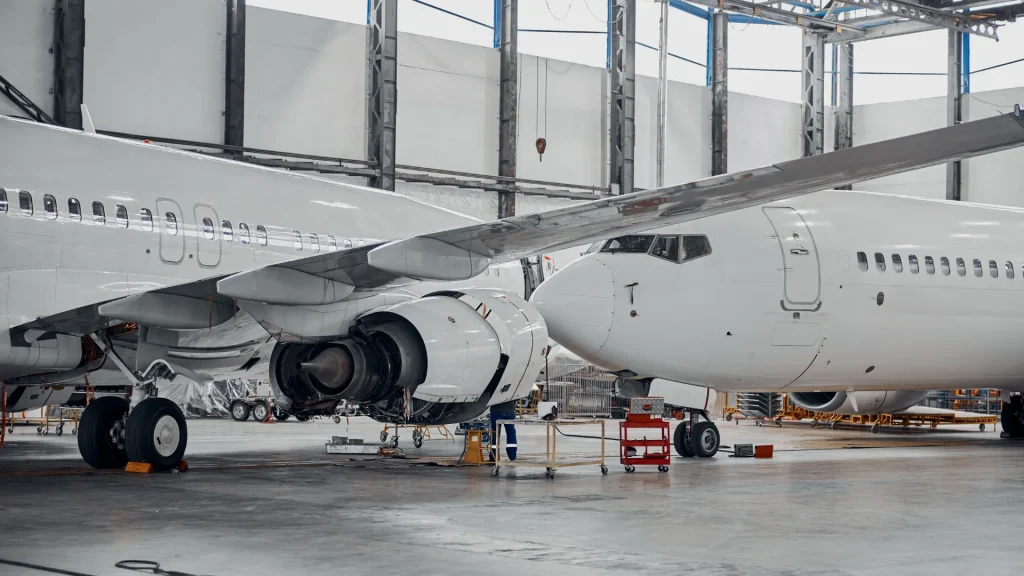
Why Lightweight Aerospace Components Matter
Weight reduction is not simply an engineering preference in aerospace — it is an economic and safety imperative. Aircraft fuel efficiency improves by roughly 1–2% for every 1% reduction in structural weight. For commercial aviation, satellite platforms, and next-generation UAVs, lightweight design directly determines range, payload capacity, and operational cost.
Modern aerospace manufacturers increasingly rely on:
- Aluminium alloys (2xxx, 6xxx, 7xxx series) for their high strength-to-weight ratio
- Titanium alloys for high-temperature structural zones
- Carbon fibre reinforced polymers (CFRP) for non-metallic structural panels
- Nickel superalloys in turbine and engine components
All of these materials present specific joining challenges. They are sensitive to heat, prone to warping under conventional welding, and demand weld integrity that traditional methods struggle to deliver consistently. This is precisely where precision laser welding changes the manufacturing equation.
Challenges in Traditional Aerospace Welding
Before laser welding became mainstream, aerospace manufacturers relied on TIG (Tungsten Inert Gas) welding, electron beam welding, and resistance spot welding. Each of these carries limitations when applied to lightweight, thin-gauge, or thermally sensitive aerospace components:
| Challenge | Traditional Welding | Laser Welding |
| Heat-Affected Zone (HAZ) | Large causes grain growth and distortion | Minimal preserves base metal properties |
| Weld Speed | Slow limits throughput | High improves cycle time significantly |
| Distortion Risk | High especially on thin sheets | Very low narrow, focused energy input |
| Weld Geometry | Limited difficult on complex 3D paths | Flexible adaptable to 2D and 3D profiles |
| Repeatability | Operator-dependent | CNC-driven, fully repeatable |
| Post-Weld Finishing | Extensive grinding, straightening | Minimal clean, near-net-shape welds |
| Material Compatibility | Limited for dissimilar metals | Broad including dissimilar material joining |
The consequences of poor welds in aerospace are severe: structural failure, fatigue cracking, non-conformance rejections, and costly rework. Traditional methods, while proven in lower-precision industries, often fall short of the consistency demands in modern aerospace supply chains.
How Laser Welding Reduces Heat Distortion
One of the most critical technical advantages of laser welding for aerospace applications is its dramatically reduced heat input compared to arc-based processes. Here is how it works:
Concentrated energy delivery: The laser beam is focused to a spot diameter as small as 0.1–0.6 mm. All thermal energy is applied precisely to the weld zone, not spread across the surrounding material.
High power density: Power densities exceeding 10⁶ W/cm² allow the metal to be melted and resolidified almost instantly. The surrounding base metal does not have time to heat up significantly.
Narrow weld bead: The resulting fusion zone is narrow and deep often described as a “keyhole” weld which means the volume of thermally altered material is a fraction of what conventional welding produces.
Low distortion: With minimal HAZ, aluminium aerospace panels, sandwiched aluminium sheet structures, and thin-wall titanium housings retain their dimensional accuracy after welding. Fixturing and post-weld correction requirements drop substantially.
Controlled atmosphere welding: When combined with inert gas shielding (argon or helium), laser welding prevents oxidation and porosity critical for aerospace-grade metallurgical quality.
Benefits of Laser Welding for Aerospace Components
The shift toward laser welding in aerospace manufacturing is driven by a combination of technical, operational, and commercial benefits:
Precision Joining on Complex Geometries
Laser welding machines can follow complex 3D weld paths under CNC control essential for joining curved fuselage sections, engine cowlings, and multi-axis brackets. Articulated laser heads allow five-axis and six-axis welding without repositioning the part.
Lightweight Assembly Without Compromise
By eliminating the need for mechanical fasteners (rivets, bolts) in many assemblies, laser welding reduces component count and overall structural weight. Riveted aluminium panels can be replaced with precision-welded assemblies that are both lighter and structurally superior.
Welding of Dissimilar Materials
Advanced laser systems can join dissimilar metal combinations such as aluminium to steel, or titanium to nickel alloys that are impossible to join with conventional processes. This opens new design possibilities for multi-material aerospace structures.
High Repeatability for Production-Scale Manufacturing
In high-volume aerospace production, consistency is critical. CNC laser welding systems replicate the same weld profile on every part, eliminating the variability inherent in manual TIG welding. This directly supports first-article inspection (FAI) compliance and AS9100 quality certification requirements.
Reduced Post-Processing
Because laser welds are clean, narrow, and near-net-shape, the amount of post-weld grinding, straightening, and non-destructive testing (NDT) required is significantly reduced. This improves throughput and lowers per-unit cost.
Integration with Laser Cutting and Marking Workflows
Laser welding does not operate in isolation on the aerospace shop floor. It is typically part of an integrated laser processing workflow that includes precision laser cutting of blanks and structural members, 3D laser cutting of complex tubular and formed profiles, and laser marking for part traceability and serialisation. This seamless integration reduces handling time, improves positional accuracy between operations, and supports digital manufacturing traceability requirements.
Applications of Laser Welding in Aerospace Manufacturing
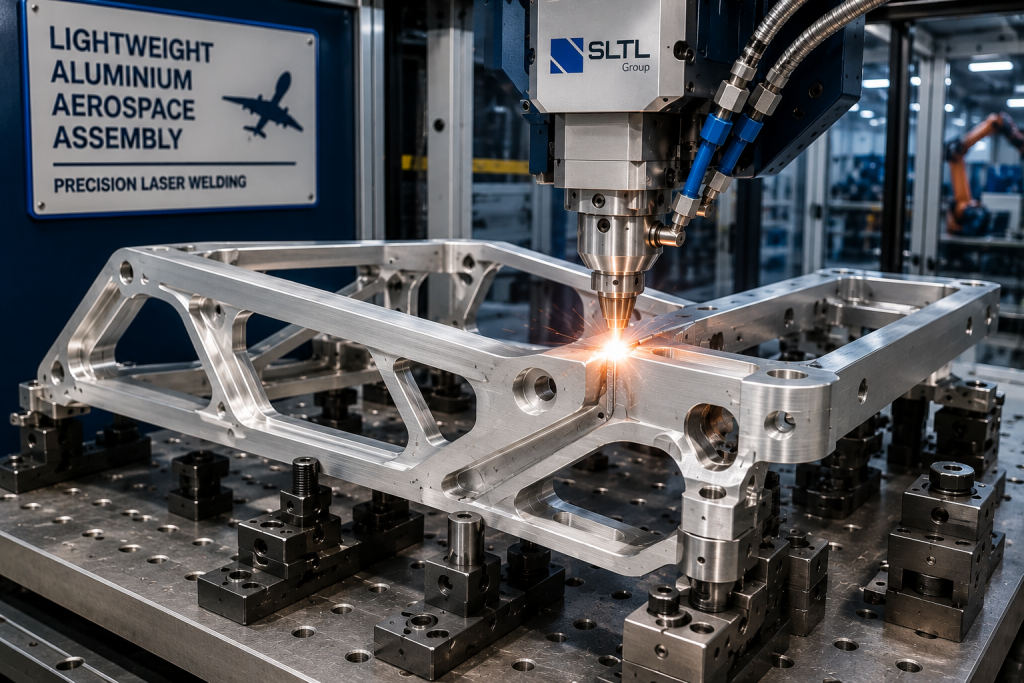
Laser welding is now applied across a wide spectrum of aerospace structures and sub-assemblies:
Structural Airframe Components
Wing ribs, fuselage frames, and floor beams fabricated from aluminium alloy sheet and extrusions are joined with laser welding to achieve tight tolerances and minimal distortion. Sandwiched aluminium sheet cutting produces lightweight panel cores that are subsequently laser-welded into structural sandwich assemblies.
Engine and Turbine Components
High-temperature alloy components combustion chambers, turbine blade platforms, heat shields require deep, narrow welds with no porosity. Laser welding under inert atmosphere delivers the metallurgical quality required for these flight-critical parts.
Aerospace Tube and Pipe Assemblies
Hydraulic lines, fuel conduits, and structural tube frames require precise circumferential and longitudinal welds. Tube cutting with laser systems produces clean, square-cut pipe ends that seat perfectly for laser butt welding with zero gap tolerance.
Lightweight Brackets and Housings
Avionics housings, sensor brackets, and instrumentation enclosures fabricated from thin aluminium or titanium sheet are joined with laser welding to maintain form factor, dimensional accuracy, and EMI shielding continuity.
UAV and Satellite Structures
Unmanned aerial vehicles and small satellite (smallsat) manufacturers rely on laser-welded aluminium and CFRP-reinforced metal frames to achieve the extreme weight targets required for their missions. Composite cutting workflows prepare CFRP panels for subsequent structural bonding and laser-welded metal interface joining.
Aerospace Structural Assemblies for MRO
Maintenance, Repair, and Overhaul (MRO) operations use laser welding for precision repair of worn or damaged flight hardware restoring dimensional geometry without the material removal that grinding or machining would require.
How SLTL Supports Aerospace Manufacturing with Advanced Laser Systems
SLTL Group offers a comprehensive range of laser cutting, welding, and marking machines designed to meet the precision demands of aerospace manufacturing. Below is an overview of how each system fits into the aerospace production workflow.
Laser Cutting Machines
Precise material cutting is the foundation of every aerospace laser welding workflow. Accurate blank cutting ensures tight joint fit-up, which directly determines weld quality and dimensional conformance.
Future
The Future X is SLTL’s flagship precision cutting platform for aerospace applications. Designed for high-accuracy cutting of aluminium alloy sheet, titanium plate, and stainless steel in aerospace structural applications, it delivers the dimensional accuracy needed for zero-gap laser weld preparation. Ideal for cutting wing skin panels, fuselage frame blanks, and structural gussets.
Infinity F1
For aerospace manufacturers processing thick-section plate or high-strength alloys, the Infinity F1 provides the raw cutting power to handle heavy-duty aerospace structures. Suitable for cutting large structural members, bulkhead frames, and thick titanium component blanks that are subsequently welded into primary structures.
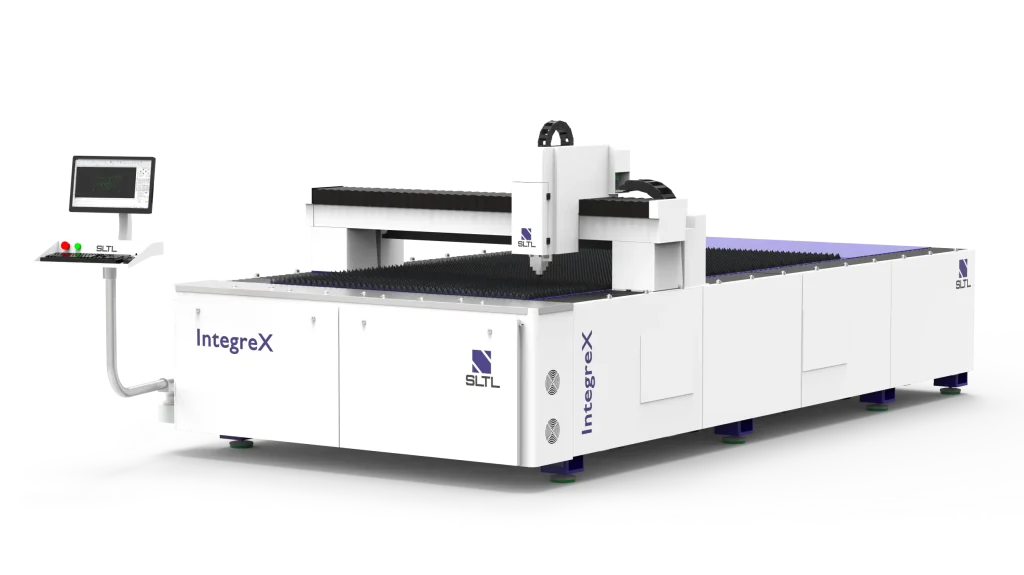
IntegreX
The IntegreX offers an accessible entry point for aerospace sub-contractors and Tier 2 suppliers who need consistent, repeatable cutting of lightweight aluminium and stainless components. Suited for bracket cutting, enclosure blanking, and standardised panel production in medium-volume aerospace runs.
X5
The X5 is purpose-built for cutting complex 3D profiles — essential for aerospace tube cutting, formed section trimming, and composite cutting of non-flat structural panels. In aerospace workflows, the X5 prepares curved fuselage panels, structural tubes, and complex formed brackets for downstream laser welding operations.
Laser Marking Machines
Aerospace traceability is a mandatory compliance requirement. Every flight-critical component must carry a permanent, machine-readable identification mark typically a Data Matrix code, serial number, or part number that survives the life of the aircraft. SLTL’s marking systems provide the 2D/3D marking capability required across aluminium, titanium, CFRP, and polymer aerospace components.
For a deeper look at traceability requirements, see our supporting blog: Laser Marking for Aerospace Traceability
Nova
The Nova provides clean, high-contrast marks on aluminium and anodised aerospace components. Suitable for marking lightweight brackets, enclosures, and instrumentation housings with part numbers and serialisation codes.
REX
The REX is optimised specifically for aerospace traceability marking producing durable Data Matrix codes and alphanumeric identifiers on metallic and composite aerospace parts that meet ATA Spec 200 and MIL-STD-130 traceability requirements.
ELITE
High-resolution fiber marking for precision identification on titanium, nickel alloy, and stainless aerospace components. The ELITE’s fine spot capability supports the small character sizes required on compact avionics and sensor housings.
Flexy
The Flexy’s portable format makes it ideal for MRO environments and large aerospace assemblies that cannot be brought to a fixed marking station. Technicians can mark repaired components, assemblies, and tooling in-situ.
NEO
The NEO handles deep engraving and high-speed marking on hardened aerospace alloys. Suitable for marking engine components, landing gear elements, and other high-wear flight hardware that must retain traceability marks throughout years of operational service.
Ultra
A versatile solution for lower-volume aerospace part marking, the Ultra serves prototype shops, certification labs, and Tier 3 aerospace suppliers who need reliable identification marking without dedicated high-throughput equipment.
OptiFly
Aerospace interiors incorporate significant volumes of polymer and composite components passenger cabin panels, seat frames, and avionics bay covers. The OptiFly provides clean, permanent marking on plastics and CFRP surface layers without penetrating structural fibres.
Carbon
The Carbon CO₂ system supports marking of non-metallic aerospace materials including CFRP panels, glass-filled polymers, and rubber sealing components — applications where fibre laser wavelengths are less effective.
Future Trends in Aerospace Laser Welding Technology
The evolution of aerospace manufacturing is pushing laser welding into new technical territory:
Remote Laser Welding (RLW)
High-power scanning laser heads mounted on robots can weld large aerospace structures at high speed without contact. RLW is already in production use for automotive body-in-white manufacturing and is being adapted for aerospace fuselage panel assembly.
Hybrid Laser-Arc Welding
Combining a laser beam with a MIG or TIG arc in a single welding head delivers the penetration depth of arc welding with the speed and low distortion of laser welding an emerging process for thicker aerospace structural sections.
Additive Manufacturing Integration
Directed energy deposition (DED) laser processes blur the line between welding and 3D printing. Aerospace manufacturers are using laser-based DED to build up near-net-shape structural features, repair worn turbine blades, and produce complex titanium fittings without subtractive machining waste.
AI-Driven Process Monitoring
Real-time monitoring of weld pool geometry, spatter emission, and plasma plume using AI vision systems is moving from research into production. Closed-loop laser power control ensures weld quality is maintained part-to-part without manual inspection intervention.
Increased Use in CFRP Joining
Next-generation laser sources are enabling direct welding of thermoplastic CFRP laminates eliminating adhesive bonding and mechanical fastening from composite aerospace assemblies entirely. This is a technically significant development that will reshape lightweight aerospace structures in the coming decade.
Frequently Asked Questions
Q: Why is laser welding preferred in aerospace manufacturing?
Laser welding is preferred because it produces narrow, deep welds with a minimal heat-affected zone, resulting in very low structural distortion — a critical requirement for aerospace-grade aluminium, titanium, and nickel alloy components. It is also fully CNC-automated, ensuring the high repeatability and part-to-part consistency demanded by aerospace quality systems such as AS9100.
Q: Which materials can be laser welded for aerospace applications?
Laser welding is effective on a broad range of aerospace materials including aluminium alloys (2024, 6061, 7075), titanium alloys (Ti-6Al-4V), nickel superalloys, stainless steel, and with appropriate laser parameters certain thermoplastic CFRP laminates. Dissimilar metal combinations, such as aluminium to steel, can also be laser welded with specialised techniques.
Q: How does laser welding reduce distortion in aerospace components?
The laser beam concentrates energy to a very small spot typically less than 1 mm in diameter with power densities that melt and resolidify metal in milliseconds. This means the surrounding base material is exposed to very little heat, dramatically reducing the thermal gradient that causes distortion in conventional arc welding processes.
Q: What is the best laser welding machine for lightweight aerospace parts?
The optimal machine depends on component geometry, material, and production volume. For small-to-medium aerospace brackets and housings, a fibre laser welding system with 1–3 kW output and CNC positioning is typically appropriate. For larger structural assemblies or thicker sections, higher-power systems (4–10 kW) with multi-axis robotic integration are preferred. SLTL offers consulting support to match the right system to your specific aerospace application.
Q: Can laser welding support aerospace traceability requirements?
Yes. While laser welding itself produces the structural joint, it integrates naturally with laser marking in an end-to-end workflow. After welding, components are marked with Data Matrix codes, serial numbers, or part identifiers using SLTL marking systems such as the REX or NEO. These marks are permanent, machine-readable, and compliant with aerospace traceability standards including ATA Spec 200 and MIL-STD-130.
Q: Is laser welding suitable for aerospace tube and pipe assemblies?
Absolutely. Laser welding is widely used for aerospace hydraulic lines, structural tube frames, and fuel conduit assemblies. When combined with precision tube cutting using SLTL’s X5 3D laser cutting machine, the system produces clean, square-cut tube ends with zero gap — ideal for high-quality circumferential and longitudinal laser butt welds.
Q: How does laser welding compare to electron beam welding for aerospace?
Both processes produce deep, narrow welds with low HAZ. Electron beam welding requires a vacuum chamber, limiting part size and throughput. Laser welding operates in atmosphere (or with local gas shielding), supports larger assemblies, integrates into standard CNC production lines, and does not require the capital-intensive vacuum infrastructure of electron beam systems making it the more scalable option for aerospace production.
Conclusion
Laser welding has moved from a specialised aerospace process to a mainstream production technology and for good reason. Its ability to join lightweight aerospace materials with minimal distortion, high precision, and full automation addresses the core manufacturing challenges that define modern aerospace supply chains.
From sandwiched aluminium sheet cutting and precision tube cutting to 2D/3D marking and composite cutting workflows, laser processing technologies work together as an integrated system not as isolated operations. The precision, repeatability, and material compatibility of laser welding make it indispensable for aerospace structural assemblies, lightweight brackets and housings, engine components, and UAV structures at every scale of production.
As aerospace programmes demand lighter structures, tighter tolerances, and faster production cycles, the manufacturers who invest in advanced laser processing systems will be the ones delivering the next generation of flight hardware. The question is no longer whether to adopt laser welding — it is how quickly and comprehensively to integrate it into your production workflow.