
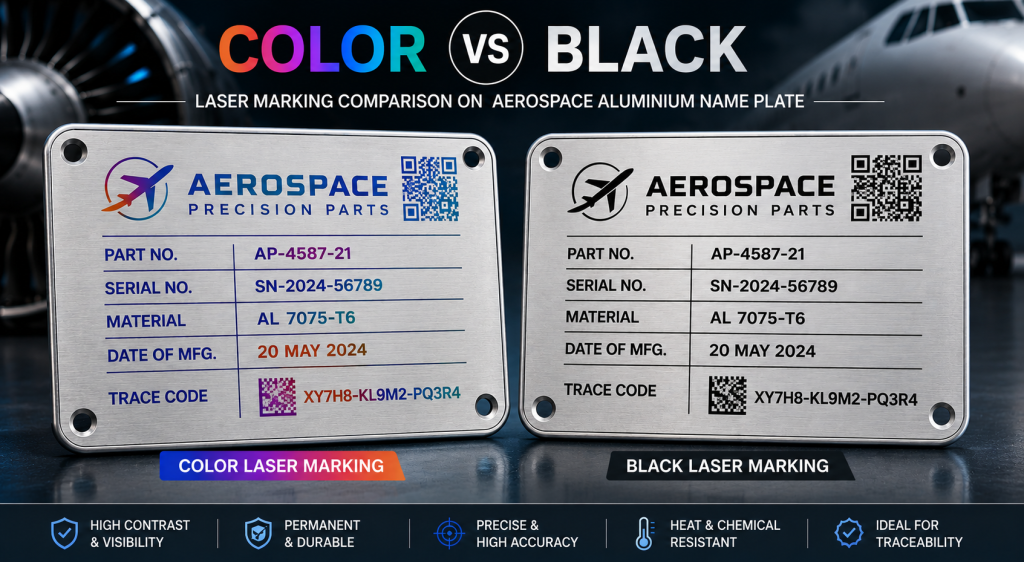
When it comes to permanently identifying aerospace components, the choice between color vs black marking aerospace applications is more consequential than most manufacturers initially realize. Both methods produce laser-permanent marks but they differ fundamentally in how they interact with the material surface, how well they perform under aerospace operating conditions, and how reliably they can be read by automated traceability systems.
Whether you are marking titanium structural components, stainless steel fasteners, aluminium name plates, or composite panels, selecting the wrong marking method can result in non-compliant traceability codes, poor scanner readability, or marks that degrade under heat and chemical exposure. As a result, this guide breaks down the key differences, explains which method suits which aerospace application, and helps you choose the right laser marking machine for your production line.
Related Reading: Why Aerospace Manufacturers Need High-Accuracy Laser Processing a comprehensive guide to precision laser technology across the aerospace manufacturing workflow.
Why Aerospace Parts Require Permanent High-Contrast Marking
The Stakes Are Higher Than in Any Other Industry
Aerospace is one of the few industries where a missing or unreadable part mark is not simply an inconvenience. It is a regulatory failure. Every serialized component that enters an aircraft structure, engine assembly, or avionics system must carry a permanent, machine-readable identification mark. That mark must survive the full operational life of the part.
In practice, the mark must withstand extreme temperature cycling, vibration, hydraulic fluid exposure, and cleaning chemicals. In some cases, it must also resist high-altitude UV radiation. Consequently, surface-applied methods like inkjet printing, adhesive labels, or chemical etching do not meet most aerospace traceability specifications.
What International Standards Require
Aerospace traceability standards drive every marking decision. Key standards include AS9100, MIL-STD-130, AMS 2750, and EASA Part 21. Together, they mandate that part identification must meet four core criteria.
- Permanent: The mark must not fade, peel, or degrade under operational conditions.
- Machine-readable: Data Matrix codes must achieve Grade A or B per ISO/IEC 15415 and AIM DPM standards.
- Traceable: The mark must link the physical part to its certification, batch, production date, and serialization records.
- Non-damaging: The marking process must not compromise the structural integrity or fatigue life of the component.
Why Laser Marking Is the Industry Standard Solution
Laser marking satisfies all of these requirements at once. Unlike mechanical or chemical methods, a laser alters the material surface at the microstructure level. It creates a permanent change in reflectivity, oxidation state, or surface texture. Importantly, it does this without adding or removing bulk material. Therefore, the resulting mark has no raised edges, no chemical residue, and no risk of delamination.
Not all laser marks are the same, however. Specifically, the choice between color laser marking and black laser marking determines contrast, scanner compatibility, durability, and regulatory suitability for your application.
Color Laser Marking vs Black Laser Marking in Aerospace
What Is Black Laser Marking?
Black laser marking is also known as laser annealing or oxidation marking. It works by rapidly heating the metal surface without removing material. As a result, controlled oxidation occurs at the surface. This creates a dark, high-contrast mark that sits within the material itself. The mark depth is typically only a few microns. Therefore, the base material properties stay fully intact.
Black marking is the most widely used method for aerospace traceability. It delivers:
- Extremely high contrast on bright metallic surfaces
- Grade A data matrix readability on titanium, stainless steel, and Inconel
- No stress concentration, which is critical on fatigue-sensitive flight components
- Chemical resistance, because the mark forms part of the material oxide layer
What Is Color Laser Marking?
Color laser marking works by precisely controlling laser pulse duration, frequency, and energy density. This produces different thin-film interference effects at the metal surface. Depending on the parameters, the result can be gold, blue, green, purple, or red. No pigment, coating, or added material is involved.
This technique works particularly well on titanium. Titanium responds to controlled oxidation with a vivid, stable colour spectrum. Manufacturers also use it on stainless steel for identification, aesthetic differentiation, and premium product marking. However, colour marks generally offer lower contrast under automated scanner conditions compared to black marks. This is an important consideration for data matrix traceability applications.
Direct Comparison: Black vs Color Laser Marking
| Attribute | Black Laser Marking | Color Laser Marking |
| Primary mechanism | Controlled oxidation (annealing) | Thin-film surface interference |
| Contrast for scanning | Very high, ideal for data matrix | Moderate, depends on material and background |
| Material suitability | Titanium, steel, Inconel, aluminium | Titanium, stainless steel |
| Marking depth | Minimal (micron-level) | Minimal (micron-level) |
| Structural impact | None | None |
| Durability | Excellent, chemically bonded to surface | Very good, but may vary under harsh chemical exposure |
| Regulatory use | Primary aerospace traceability standard | Supplementary identification, branding, differentiation |
| Automation readability | Excellent | Good for human reading; variable for scanners |
| Typical application | Data matrix, serial numbers, part IDs | Name plates, premium part identification, colour coding |
Which Method Should You Choose?
For automated traceability and compliance marking, black laser marking is the correct choice in almost all cases. This includes data matrix codes, serial numbers, and part identification required under AS9100 or MIL-STD-130. Furthermore, aerospace OEMs and certification bodies expect to see black laser marking in traceability audits.
For name plate marking, visual differentiation, colour-coded part families, or premium branding, colour laser marking adds significant value without compromising part integrity. In many aerospace production environments, manufacturers use both methods. Black marking handles data matrix traceability codes. Colour marking handles human-readable name plate information and visual identification.
Which Aerospace Materials Require Different Marking Methods?
Titanium: The Most Versatile Laser Marking Material
Titanium is the premier laser marking material in aerospace. It responds exceptionally well to both black annealing and colour marking. It produces crisp, high-durability results across a wide range of laser parameters. Specifically, a fiber laser can easily manipulate the natural oxide layer of titanium. This enables reliable Grade A data matrix codes in black and vivid, stable colour marks for name plate marking and part differentiation.
Manufacturers routinely mark titanium components using 2D data matrix codes for full supply chain traceability. These components include turbine blades, structural brackets, engine mounts, and fasteners. Additionally, manufacturers increasingly use 3D laser marking for curved titanium components. Standard flat-field optics cannot maintain consistent focal distance across these surfaces.
Stainless Steel: High-Contrast Black Marking for Harsh Environments
Stainless steel is widely used in aerospace hydraulic systems, fasteners, and structural fittings. For this material, black laser marking through annealing is the dominant choice. It delivers extremely high contrast without material removal. As a result, the mark withstands hydraulic fluid exposure, cleaning agents, and temperature cycling without degradation.
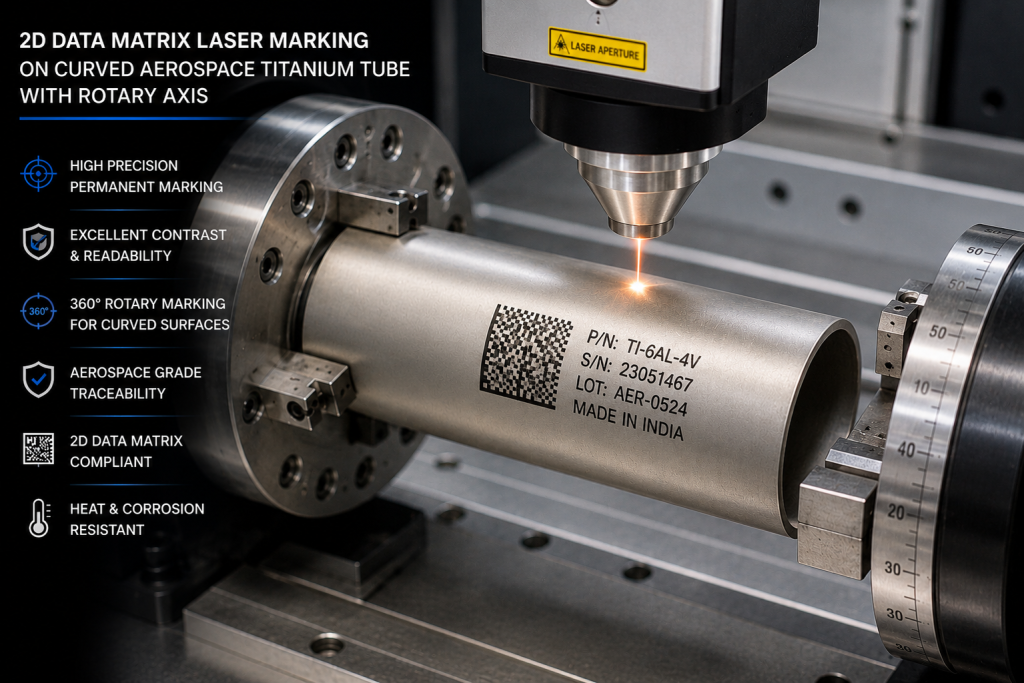
Colour marking is also achievable on stainless steel, though the colour range is narrower than on titanium. For tube cutting applications, manufacturers need to mark serial numbers and part codes around curved circumferences. Rotary-axis fixtures combined with fiber laser systems produce consistent black marks that maintain Grade A readability in these cases.
Aluminium and Anodized Aluminium: Name Plate and Identification Marking
Aluminium presents different marking dynamics compared to steel or titanium. In particular, anodized aluminium responds to laser ablation. The laser removes the anodized surface layer to expose the bright base material beneath. This creates a high-contrast white or silver mark on a coloured background. Aerospace manufacturers use this technique as the standard method for name plate marking, identification tags, and equipment labels.
Sandwiched aluminium sheet uses aluminium face skins over a honeycomb core. This construction is common in fuselage interior panels and increasingly used in secondary structure. Marking these panels requires precise energy control. The laser must affect only the surface layer without penetrating or heat-affecting the core material.
Coated and Painted Aerospace Components
Many aerospace structural components carry protective coatings such as primer, topcoat, or anodizing. The marking approach must account for these coatings. In most cases, ablation marking removes the coating to expose the bare metal beneath. Consequently, engineers must tune laser parameters carefully to clear the coating completely without affecting the base material.
For components that get recoated during service, the engraving depth must be sufficient to survive the recoating process. The mark must remain readable after subsequent treatments.
Composite Materials: CO2 Laser for Non-Metallic Marking
Carbon fibre reinforced polymer (CFRP) and composite panels used in aerospace structures require CO2 laser marking rather than fiber laser. CO2 wavelengths are absorbed efficiently by polymer matrix materials. This enables clean, high-contrast marking without fibre damage. Using the wrong wavelength can damage the fibre structure. Therefore, CO2 systems are essential for composite cutting and marking workflows.
How to Choose the Right Laser Marking Machine for Aerospace Parts
Start with Your Material and Marking Method
The first decision is always the combination of material type and required marking method. Fiber lasers handle metals such as titanium, steel, Inconel, and aluminium for both black and colour marking. CO2 lasers handle composites, polymers, and non-metallic substrates. Diode lasers offer a cost-effective middle ground for medium-duty traceability marking on standard aerospace metals.
Consider Part Geometry: Flat, Curved, or Complex 3D
Flat components such as panels, plates, and name plates are the most straightforward to mark. Curved components such as tubes, fittings, and cylindrical housings require rotary-axis capability. This maintains constant focal distance and consistent mark quality around the circumference.
For compound-curved surfaces such as turbine blade roots, aerofoil leading edges, or complex engine housings, 3D laser marking with dynamic focus adjustment is specifically required. Standard flat-field systems cannot handle these geometries accurately.
Match Power to Marking Depth and Speed Requirements
Power range directly determines engraving depth, marking speed, and throughput capacity. Lower power systems in the 20 to 60W fiber range provide the precision needed for light traceability marking on thin-wall components. They do this without the risk of over-penetration.
For high-power, deep-engraved traceability codes on tough alloys, higher power systems in the 200 to 500W range are necessary. This applies particularly where marks must survive re-machining or recoating.
Evaluate Automation Compatibility
In high-volume aerospace production, the laser marking machine must integrate with the surrounding workflow. Confirm compatibility across these areas:
- MES and ERP systems for automated serial number generation
- Conveyor and robotic part handling systems
- Inline vision verification systems for data matrix grade checking
- I/O and Ethernet communication interfaces
Assess Data Matrix Readability Compliance
Before selecting a machine, always request a sample marking test on your specific material. Verify the output with a calibrated data matrix code verifier to ISO/IEC 15415. Furthermore, ensure the machine maintains consistent parameter accuracy across a full production run. Parameter drift is a common cause of Grade B or C code quality in long production cycles.
\
Recommended SLTL Laser Machines for Aerospace Marking and Manufacturing
Laser Marking Machines Matched to Aerospace Applications
SLTL’s laser marking range covers every aerospace marking scenario. Options include high-power certified traceability systems and portable on-site machines for large assemblies.
Nova (200 to 500W Fiber): The Nova handles demanding, high-volume traceability marking on the toughest aerospace alloys. It delivers the power needed for deep, permanent black marks on Inconel, titanium, and hardened steels. This makes it the preferred choice for Tier 1 OEM traceability lines. Explore the SLTL Nova Laser Marking Machine.
NEO (20 to 60W Fiber): The NEO is a multipurpose high-power fiber laser marking system suitable for a broad range of aerospace metals. It works particularly well for data matrix marking, serial number engraving, and name plate marking where precision and repeatability are essential at standard production volumes.
Ultra (20 to 120W Fiber): The Ultra offers a wide power range. This makes it adaptable across a variety of aerospace metal specifications, from lightweight traceability marking on aluminium brackets to deeper engraving on thicker steel components. It is therefore a flexible choice for aerospace job shops handling mixed part types.
REX (Diode Laser): Engineers designed the REX specifically for traceability marking applications on anodized aluminium and painted aerospace surfaces. It provides reliable, cost-effective marking for Tier 2 and Tier 3 suppliers who need consistent data matrix output without the capital cost of a high-power fiber system.
Flexy (Movable Diode Laser): Large aerospace assemblies and structural components often cannot move to a fixed marking station. The Flexy provides portable, on-site marking capability for exactly these situations. It is consequently ideal for aerospace MRO environments and for marking large fuselage panels, structural beams, and tooling fixtures in place.
ELITE (Fiber Hallmarking): The ELITE suits high-precision marking on aerospace identification components, precision instruments, and small serialized parts where exceptional mark resolution is required.
OptiFly (CO2 Plastic and Composite Marking): The OptiFly delivers high-speed CO2 marking for non-metallic aerospace materials in mass production environments. These materials include composite panels, polymer cable markers, and avionics labelling substrates. It is the correct choice for all composite cutting and marking workflows where fiber lasers are unsuitable.
Carbon (CO2 Laser): The Carbon provides reliable, general-purpose CO2 marking for aerospace non-metal applications. These include nameplate substrates, composite panels, and insulation materials.
Laser Cutting Machines: Completing the Aerospace Workflow
Beyond marking, SLTL’s cutting systems integrate directly into aerospace production lines. They enable a seamless flow from raw material through to finished, identified component.
Future X: This is SLTL’s advanced laser cutting solution for aerospace sheet metal, structural profiles, and precision aerospace components requiring high-accuracy edge quality.
Infinity F1: This heavy-duty, high-power laser cutting system handles thick-section aerospace materials. These include sandwiched aluminium sheet cutting, heavy structural steel, and titanium plate. It meets the demanding cut quality requirements of primary aerospace structure fabrication.
IntegreX: This affordable, production-optimized laser cutting machine suits Tier 2 and Tier 3 aerospace suppliers managing medium-complexity parts at high volume.
X5 (3D Laser Cutting): The X5 is a specialized 3D laser cutting and marking system for complex three-dimensional aerospace components. These include formed sheet metal parts, tube cutting on shaped profiles, and compound-geometry structural elements that flat-bed systems cannot process effectively.
Integrating Cutting, Marking, and Welding in One Aerospace Workflow
One of the most significant production advantages SLTL offers is the ability to integrate laser cutting, laser marking, and laser welding within a single, connected aerospace manufacturing workflow. As a result, manufacturers can eliminate material handling between processes, reduce cycle times, and maintain complete traceability from the first cut to the final identification mark. Tier 1 aerospace OEMs and large precision component manufacturers increasingly adopt this integrated approach as their standard.
Related Reading: Laser Cutting for Aerospace Composite and Metal Components – how to select the right laser cutting system for composite panels, sandwiched aluminium, and precision aerospace profiles.
Why Aerospace Manufacturers Choose SLTL Laser Solutions
Precision and Repeatability Across Every Production Run
Aerospace production does not tolerate variation. SLTL laser marking and cutting systems maintain consistent parameter accuracy across thousands of parts. The first marked component and the ten-thousandth carry marks of identical quality and readability. AS9100-certified production environments require this level of repeatability as a baseline standard.
Automation-Ready for Modern Aerospace Production Lines
SLTL systems are built with industrial automation integration in mind. Whether you need inline conveyor marking, robotic part loading, MES-connected serial number generation, or post-marking vision verification, SLTL machines deliver the I/O interfaces, software connectivity, and workflow compatibility needed. They slot directly into your existing production architecture.
Complete Aerospace Laser Processing from One Supplier
Managing separate suppliers for cutting, marking, and welding adds complexity and cost. SLTL covers fiber laser marking, CO2 marking, 3D laser cutting, and laser welding within a unified product ecosystem and a single support relationship. Aerospace manufacturers increasingly value this complete-solution approach.
Frequently Asked Questions
Q1: What is the difference between color laser marking and black laser marking for aerospace applications?
Black laser marking uses controlled oxidation to create a dark, high-contrast mark directly within the metal surface. It is the standard method for data matrix traceability codes on aerospace components. Colour laser marking uses thin-film interference at the surface to produce vivid colours without any pigment or coating. In aerospace, manufacturers use black marking primarily for machine-readable traceability. They use colour marking for name plate marking, visual identification, and part differentiation where a human-readable or aesthetically differentiated mark is needed.
Q2: Which laser marking method is required for aerospace traceability compliance?
Black laser marking, specifically annealing or oxidation marking using a fiber laser, is the method most widely accepted under AS9100, MIL-STD-130, and AIM DPM traceability standards. It produces high-contrast Grade A data matrix codes that automated scanners can reliably read. Colour marking is permanent and non-damaging. However, manufacturers generally use it in a supplementary role for name plates and visual identification rather than as the primary traceability mark.
Q3: Which SLTL machine is best for black marking data matrix codes on titanium aerospace parts?
For titanium aerospace traceability marking, the SLTL Nova (200 to 500W) is the most capable option for high-volume and high-power applications. The NEO (20 to 60W fiber) and Ultra (20 to 120W fiber) are well suited for standard production volume marking. The best choice depends on your required throughput, engraving depth, and part complexity. SLTL recommends requesting a sample marking test before final machine selection.
Q4: Can laser marking damage the structural integrity of aerospace components?
When engineers configure parameters correctly, laser marking does not affect the structural properties of aerospace components. Annealing-type black marks operate at the microstructure surface level. No material removal occurs and no significant heat-affected zone forms. Furthermore, engineers must always validate engraving depth against the component design specification. This is particularly important on fatigue-sensitive thin-wall parts. SLTL provides application support to help manufacturers validate parameters against their specific component standards.
Q5: What maintenance does an aerospace laser marking machine require?
Fiber laser sources, including those in the Nova, NEO, Ultra, REX, and ELITE, are solid-state systems. They have no consumable gas or optical components that require regular replacement. Typical maintenance involves periodic cleaning of the f-theta lens and protective window, verification of beam alignment, and focal distance calibration checks. CO2 systems such as the OptiFly and Carbon additionally require attention to the laser gas supply and beam delivery optics. Overall, SLTL designs fiber laser systems for high-uptime, low-maintenance aerospace production environments.
Q6: Can SLTL laser marking machines integrate with our existing ERP or MES system?
Yes. SLTL laser marking systems support standard industrial communication protocols including Ethernet TCP/IP, OPC-UA, and digital I/O interfaces. As a result, they receive serial number data, part codes, and production instructions directly from your ERP or MES platform. This enables fully automated, error-free serialization without manual data entry. This integration is particularly important for aerospace manufacturers operating under AS9100 traceability requirements.
Q7: How do I decide between a fiber laser and a CO2 laser for aerospace marking?
The material determines the laser type. Fiber lasers at 1064 nm wavelength are the correct choice for all metallic aerospace materials. These include titanium, stainless steel, Inconel, and aluminium. They produce both black and colour marks. CO2 lasers at 10,600 nm wavelength are required for non-metallic materials. These include CFRP composites, polymer insulators, and nameplate substrates. For aerospace manufacturers processing both metal and composite components, integrating both fiber and CO2 systems is often the most effective approach. SLTL can advise on the right configuration for your specific production mix.