
Aerospace frames and support structures demand cutting accuracy that conventional fabrication methods simply cannot deliver consistently. Tube laser cutting aerospace applications have changed how manufacturers approach lightweight structural fabrication, tight-tolerance profiling, and repeatable production across titanium, aluminium, and stainless-steel tube components.
This guide explains why tube laser cutting has become the preferred method for aerospace structural manufacturing, what challenges it solves, and how to choose the right system for your production requirements.
Related Reading: Why Aerospace Manufacturers Need High-Accuracy Laser Processing – a detailed guide to precision laser technology across the full aerospace manufacturing workflow.
Why Tube Laser Cutting Matters in Aerospace Manufacturing
The Structural Accuracy Problem in Aerospace Fabrication
Aerospace frames and support structures carry critical loads. Every joint, mitre cut, and profile notch in a tube assembly must meet exact dimensional tolerances. A deviation of even a fraction of a millimetre in a tube end profile can create misalignment in the assembled structure. As a result, this misalignment compounds across multiple joints and creates fit-up problems at welding, fastening, and bonding stages.
Conventional tube cutting methods such as band sawing, angle grinding, or manual plasma cutting cannot hold the tolerances that aerospace structural fabrication requires. In addition, they leave burrs, heat-affected zones, and surface irregularities that demand secondary processing before parts move to the next stage. This adds cost and time to every production cycle.
How Tube Laser Cutting Addresses These Problems
Tube laser cutting uses a CNC-controlled fiber laser head that moves around the tube in multiple axes simultaneously. The system profiles, notches, slots, and mitre-cuts tubes with a single setup and no manual repositioning. As a result, every cut feature on the tube relates back to a single, accurate datum. This eliminates the cumulative positioning errors that build up when operators reposition tubes manually between cutting operations.
The laser cuts without mechanical contact. Therefore, no cutting forces act on the tube. This is particularly important for thin-wall aerospace tubes in aluminium and titanium alloys, where mechanical cutting tools can deform the tube cross-section and alter the profile geometry.
Challenges in Aerospace Tube and Profile Cutting
Working with Aerospace-Grade Materials
Aerospace tube fabrication involves a specific set of materials, each with different cutting characteristics. Titanium alloys are hard, heat-sensitive, and prone to work hardening under mechanical cutting. Aluminium alloys in aerospace grades are softer but require clean cuts without burrs to avoid stress concentrations at structural joints. Furthermore, stainless steel tubes used in hydraulic and structural applications need accurate profile cuts with minimal heat-affected zones to preserve corrosion resistance near cut edges.
Each of these materials responds differently to cutting parameters. Consequently, laser systems must precisely control power, speed, assist gas pressure, and focal position to produce optimal cut quality on each alloy. This is where machine capability and application knowledge intersect.
Complex Tube Geometries in Aerospace Structures
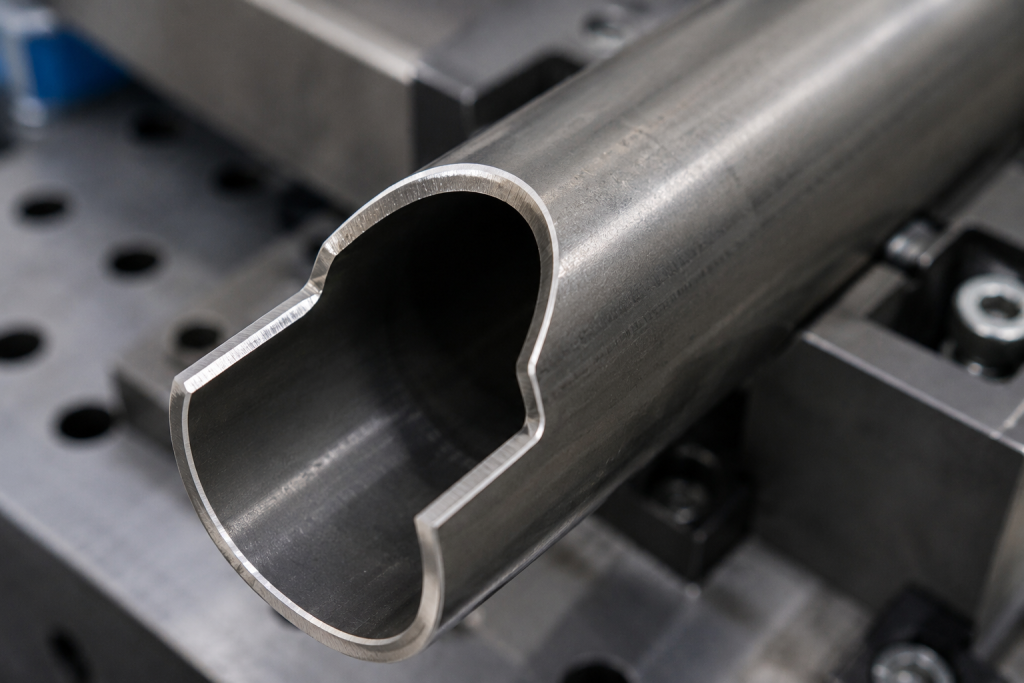
Aerospace structural assemblies rarely use simple straight-cut tube ends. Instead, frame members, truss nodes, and support struts typically require compound mitre cuts, saddle profiles, and slotted connection features. These geometries allow tubes to nest accurately against each other before welding, creating tight fit-up that minimises weld gap and reduces the amount of filler material needed.
Producing these complex profiles manually requires skilled operators and multiple setups. Moreover, even experienced operators struggle to hold consistent geometry across large production batches. A tube laser cutting machine, however, produces these profiles automatically from CAD data. Every part in the batch matches the geometry of the first part cut.
Tight Tolerances and Fit-Up Requirements
Aerospace structural welding standards require tight joint fit-up. In most cases, the weld gap must stay within 0.1 to 0.3 mm across the full joint length. Achieving this consistently demands tube end profiles accurate to within similar tolerances.
Tube laser cutting systems routinely hold positional tolerances of plus or minus 0.1 mm or better on profile cut features. Therefore, this eliminates the manual fitting, grinding, and shimming that conventional tube fabrication requires before welding can begin.
Benefits of Tube Laser Cutting for Aerospace Frames and Support Structures
Burr-Free Cuts and Minimal Heat-Affected Zones
A fiber laser cutting aerospace tubes produces cuts that are clean, square, and largely free of burrs. The heat input is highly localised and controlled. As a result, the heat-affected zone at the cut edge is narrow and shallow. This preserves the mechanical properties of the base material close to the cut edge and avoids the grain coarsening that wide heat-affected zones cause in titanium and high-strength aluminium alloys.
Burr-free cuts are particularly important in aerospace tube assemblies. Burrs on tube ends create stress concentration points at structural joints and can contaminate the internal bore of hydraulic or pneumatic tubes. Removing burrs manually adds processing time and introduces the risk of dimensional damage to precision profiles. Consequently, laser cutting eliminates this requirement in most cases.
Reduced Secondary Processing
Conventional tube cutting requires deburring, grinding, and often re-profiling after cutting to bring parts to the required dimensional standard. Each of these steps adds labour, time, and handling risk. Tube laser cutting, however, produces parts that move directly from the cutting machine to welding, assembly, or inspection in most applications. This shortens the fabrication cycle and reduces work-in-progress inventory between stages.
Production Repeatability Across Large Batches
Aerospace production managers need consistency. The tube profile cut on part number one of a batch must match part number five hundred. CNC tube laser cutting achieves this because the machine reads the same CAD program for every part. There is no operator skill variation, no tool wear, and no re-setup between parts. As a result, every part comes off the machine to the same dimensional standard.
This repeatability is essential for aerospace suppliers operating under AS9100 quality management systems. In particular, it simplifies first-article inspection, reduces the frequency of in-process dimensional checks, and supports a predictable, controlled production process.
Faster Fabrication Cycles
Tube laser cutting machines process multiple cut features in a single automated setup. For example, a tube that requires six notches, two saddle profiles, and two mitre cuts on its ends completes all of those features in one uninterrupted machine cycle. Conventional methods require multiple setups, multiple machines, and multiple operators for the same part. The result is therefore a significant reduction in total fabrication time per part and per batch.
Repeatability and Precision in Aerospace Manufacturing
Why Repeatability Is a Structural Safety Requirement
In aerospace structural manufacturing, repeatability is not simply a quality target. It is a structural safety requirement. Frames and support structures that use tube members must meet load path certification requirements. This means every tube in the assembly must carry loads as the design specifies. Dimensional variation in tube profiles changes the effective load path at joints and can consequently create stress concentrations in areas the design did not account for.
Aerospace certification bodies require manufacturers to demonstrate dimensional control across production batches. CNC tube laser cutting provides a documentable, repeatable process that supports this demonstration. Furthermore, the machine generates a consistent output that quality teams can verify against CAD data and certification requirements.
Tolerances That Support Downstream Processes
Downstream processes in aerospace tube fabrication depend on upstream dimensional accuracy. Orbital TIG welding systems, for example, require consistent tube end geometry and joint fit-up to produce repeatable weld profiles without manual parameter adjustment between parts. Similarly, automated marking systems for 2D data matrix traceability codes require consistent tube surface condition and position to produce Grade A codes reliably.
When tube laser cutting holds tight tolerances on every part, downstream processes run predictably. This is therefore the foundation of automated, high-throughput aerospace tube assembly.
CNC Automation and Process Control
Modern tube laser cutting machines use multi-axis CNC systems that combine rotation, linear feed, and laser head movement in a coordinated program. These systems include automatic tube loading, in-process measurement, and part unloading in fully automated configurations.
For aerospace manufacturers running high-volume tube component production, full automation removes operator variability from every stage of the cutting process. The machine processes each tube to the same program, at the same feed rate, with the same laser parameters. As a result, this level of process control is directly compatible with AS9100 and aerospace quality management requirements.
Integration with Welding and Traceability Systems
Connecting Tube Cutting to the Welding Workflow
Tube laser cutting is most effective when it connects directly to the welding workflow. Clean, accurate tube profiles reduce weld preparation time and support consistent weld quality. In fact, many aerospace manufacturers sequence their production so that laser-cut tube components move directly to fixturing and welding without intermediate inspection holds, because the cutting process already holds the required dimensional standard.
Laser welding systems complement tube laser cutting particularly well. They deliver low heat input, narrow weld beads, and minimal distortion on thin-wall aerospace tube assemblies. Together, therefore, laser cutting and laser welding produce aerospace tube structures with tight dimensional control from raw tube to finished assembly.
Traceability Marking for Aerospace Tube Components
Every tube component in an aerospace structure requires permanent identification under AS9100 and MIL-STD-130 traceability requirements. Manufacturers must mark part numbers, serial numbers, batch codes, and data matrix codes onto each component before it enters the assembly process.
SLTL’s laser marking systems integrate directly into tube processing workflows. Specifically, the Nova (200 to 500W fiber) handles high-volume, high-power traceability marking on tough aerospace alloys including titanium and Inconel tubes. The NEO (20 to 60W fiber) handles precision data matrix marking on standard production volumes of aerospace metal tube components. In addition, the Flexy portable diode marking system handles large or awkward tube assemblies that cannot move to a fixed marking station.
Marking Solutions for Aluminium, Composites, and Non-Metals
For anodized aluminium tubes and painted aerospace structural components, the REX diode laser provides reliable, cost-effective traceability marking. For composite tube structures and non-metallic aerospace marking applications, the OptiFly CO2 system and Carbon CO2 machine deliver consistent marking on polymer and composite substrates.
Related Reading: Laser Marking for Aerospace Traceability: What Manufacturers Should Know – a detailed breakdown of traceability standards and data matrix marking requirements for aerospace components.
Choosing the Right Tube Laser Cutting Machine for Aerospace Applications
SLTL Laser Cutting Systems for Aerospace Tube Fabrication
SLTL’s laser cutting range addresses the full spectrum of aerospace tube processing requirements. Each system suits a specific combination of material, tube size, profile complexity, and production volume.
Future X: The Future X is SLTL’s advanced laser cutting solution for aerospace sheet metal and structural profiles. It handles precision tube profiling on medium-to-large diameter aerospace tubes with high accuracy and excellent cut quality on titanium, aluminium, and steel alloys.
Infinity F1: The Infinity F1 is a heavy-duty, high-power laser cutting system. It processes thick-section aerospace structural tubes, heavy-wall steel profiles, and titanium plate components that require high laser power to cut cleanly at production speed. For aerospace manufacturers cutting primary structural members, the Infinity F1 delivers the power and rigidity that thick-wall tube cutting demands.
IntegreX: The IntegreX is an affordable, productivity-focused laser cutting machine suited to Tier 2 and Tier 3 aerospace suppliers. It handles medium-complexity tube profiles at high volume without the capital cost of a premium heavy-duty system. For suppliers managing mixed aerospace tube cutting alongside other fabrication work, the IntegreX therefore provides a practical, cost-effective solution.
X5 (3D Laser Cutting): The X5 is a specialized 3D laser cutting system for complex three-dimensional aerospace components. It handles compound-curved tube profiles, formed sheet metal parts, and complex-geometry structural elements that flat-bed or standard tube laser systems cannot process accurately. For aerospace manufacturers working with complex frame nodes, hydroformed tube sections, or three-dimensionally formed structural profiles, the X5 is consequently the appropriate system.
The Rapid-G: Flexible 2D and Tube Cutting for Mixed Production
Rapid-G: Rapid-G is SLTL’s flexible 2D plus tube cutting laser system designed for aerospace manufacturers handling both sheet metal and tube fabrication. It delivers precise, repeatable cutting for aluminium, stainless steel, and structural tube components. In addition, it reduces floor space requirements, improves workflow efficiency, and supports integrated welding and marking operations.
Selecting Based on Your Production Requirements
Choosing the right tube laser cutting machine depends on several factors. Consider tube diameter range and wall thickness first. Then evaluate the complexity of profile features required. Production volume and cycle time targets determine whether a standard system or a fully automated, high-throughput configuration is appropriate. Furthermore, material mix across titanium, aluminium, and steel alloys affects the power and wavelength requirements of the system.
SLTL recommends requesting a sample cutting evaluation on your specific tube materials and profile geometries before making a final machine selection. This confirms cut quality, dimensional accuracy, and cycle time on real production parts.
Frequently Asked Questions
Q1: What dimensional tolerances does tube laser cutting achieve on aerospace structural tubes?
CNC tube laser cutting systems routinely hold positional tolerances of plus or minus 0.1 mm or better on profile cut features including notches, saddle profiles, mitre cuts, and slot features. This level of accuracy supports direct fit-up for orbital TIG welding and laser welding without manual grinding or shimming between parts. Actual achievable tolerances depend on tube material, wall thickness, and profile geometry. SLTL recommends a sample cutting test on your specific parts before production qualification.
Q2: Which aerospace tube materials can tube laser cutting machines process?
Tube laser cutting machines process all common aerospace structural tube materials. These include titanium alloys such as Ti-6Al-4V, aluminium alloys including 6061, 7075, and 2024 series, and stainless steel grades used in hydraulic and structural applications. The system cuts each material by adjusting laser power, cutting speed, and assist gas type and pressure. SLTL applications engineers advise on optimum parameters for each material and wall thickness combination.
Q3: How does tube laser cutting support aerospace traceability requirements?
Tube laser cutting produces parts with consistent dimensional quality that supports reliable automated marking. After cutting, SLTL laser marking systems apply permanent data matrix traceability codes to each tube component. These codes link the physical part to its certification, batch, serial number, and production records under AS9100 and MIL-STD-130 requirements. The cutting and marking systems integrate within the same production workflow to maintain traceability from raw tube through to finished, identified component.
Q4: Can tube laser cutting machines integrate with automated welding and assembly lines?
Yes. SLTL tube laser cutting systems support automation integration through standard industrial interfaces including Ethernet, digital I/O, and robotic cell interfaces. Cut tube components transfer automatically to downstream welding or assembly stations in fully automated configurations. This removes manual handling between processes, maintains positional consistency, and supports high-throughput production cycles appropriate for aerospace volume manufacturing.
Q5: What is the production repeatability standard for aerospace tube laser cutting?
CNC tube laser cutting produces the same profile geometry on every part in a batch because the machine reads the same CAD program without operator intervention or tool wear. In production environments running AS9100 quality management systems, this level of repeatability supports first-article approval and reduces the frequency of in-process dimensional inspection. Every part comes off the machine to the same standard, which is a fundamental requirement for aerospace structural component certification.
Q6: How does tube laser cutting reduce secondary processing in aerospace fabrication?
Laser cutting produces burr-free, clean-edge profiles in most aerospace tube applications. This eliminates the deburring, grinding, and re-profiling steps that conventional cutting methods require before parts move to welding or assembly. Parts cut on a tube laser cutting machine typically transfer directly to the next process stage. This shortens fabrication cycle times, reduces work-in-progress handling, and lowers the risk of dimensional damage during secondary processing.
Q7: What support and maintenance does SLTL provide for aerospace tube laser cutting systems?
SLTL provides full application support including sample cutting evaluation, parameter development, and production qualification assistance for new aerospace materials and profiles. Ongoing maintenance support covers fiber laser source servicing, optical component replacement, CNC system calibration, and application engineering for new profile programs. SLTL support is available for both on-site service visits and remote diagnostics through machine connectivity systems.